Licence: In copyright
Credit: Alcoholic fermentation / by Arthur Harden. Source: Wellcome Collection.
195/258 page 185
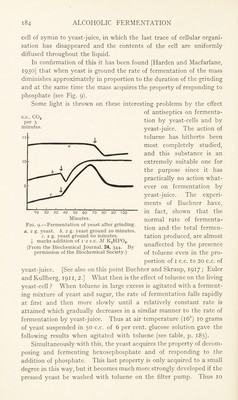
![Time after Addition of Toluene. Minutes. C.c. of C02 per Minute. Time. C.c. per Minute. O 4-6 6 i*6 I 4 8 1*2 2 3*3 12 0-85 3 2-6 24 o-8 4 2 32 o-5 5 i-8 constant grams of yeast after this treatment fermented fructose at 1*2 c.c. per three minutes ; after the addition of phosphate (5 c.c. of 0*6 molar phosphate) the rate rose to 6*9 and then gradually fell in the typical manner [Harden, 1911]. This reaction was in fact adopted by Euler and Johansson [1912, 2] for the preparation of hexosephosphate. Benzene, xylene, ether, ethyl butyrate, carbon disulphide and light petroleum [Kerr and Young, 1926 ; Harden and Macfarlane, 1930] all act like toluene, whereas some other antiseptics, e.g. formaldehyde, phenol, pyridine, etc., inhibit fermentation without rendering the yeast capable of responding to phosphate. It appears that in these latter cases the fermenting complex itself is attacked and not merely the mechanism for liberating phosphate as in the former. An explanation of the great decrease in rate of fermentation attending the action of toluene and other antiseptics on living yeast, and following upon the disintegration of the cell, which has been enter- tained, is that in living yeast the high rate of fermentation is maintained by the continued production of relatively large fresh supplies of ferment- ing complex, and that when the power of producing this catalytic agent is destroyed by the poison, the rate of fermentation falls to a low value, corresponding to the store of zymase still present in the cell [cf. Buchner, E. and H., and Hahn, 1903, pp. 176, 180]. This explanation implies that the rate of fermentation after the action of the toluene represents the amount of fermenting complex present, a supposition which has been shown (p. 182) to be highly im- probable. It further necessitates, as also pointed out independently by Euler and Ugglas [1911], a rapid destruction of the fermenting complex both in the process of fermentation and by the action of the antiseptic, as otherwise the store of zymase remaining in the dead cell would be practically the same as that contained in the living cell at the moment when it was subjected to the antiseptic, and this store would therefore suffice to carry out fermentation at the same rate in the dead as in the living cell. No such rapid destruction, however, occurs in yeast-juice, as judged by the rate of fermentation, which falls off slowly and to](https://iiif.wellcomecollection.org/image/b29808765_0195.jp2/full/800%2C/0/default.jpg)
 No text description is available for this image
 No text description is available for this image
 No text description is available for this image