Licence: In copyright
Credit: Alcoholic fermentation / by Arthur Harden. Source: Wellcome Collection.
203/258 page 193
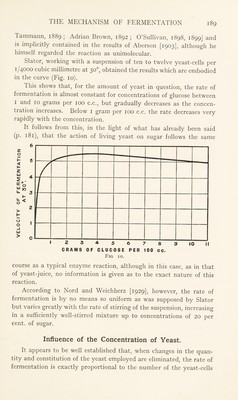
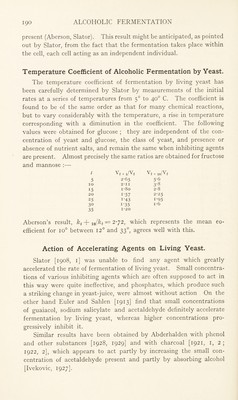
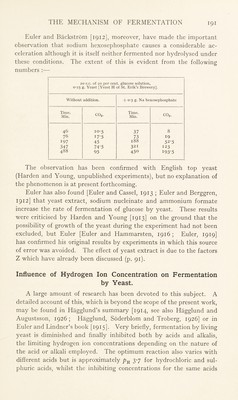
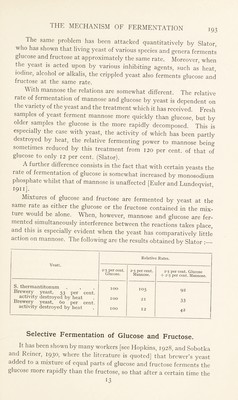
![The same problem has been attacked quantitatively by Slator, who has shown that living yeast of various species and genera ferments glucose and fructose at approximately the same rate. Moreover, when the yeast is acted upon by various inhibiting agents, such as heat, iodine, alcohol or alkalis, the crippled yeast also ferments glucose and fructose at the same rate. With mannose the relations are somewhat different. The relative rate of fermentation of mannose and glucose by yeast is dependent on the variety of the yeast and the treatment which it has received. Fresh samples of yeast ferment mannose more quickly than glucose, but by older samples the glucose is the more rapidly decomposed. This is especially the case with yeast, the activity of which has been partly destroyed by heat, the relative fermenting power to mannose being sometimes reduced by this treatment from 120 per cent, of that of glucose to only 12 per cent. (Slator). A further difference consists in the fact that with certain yeasts the rate of fermentation of glucose is somewhat increased by monosodium phosphate whilst that of mannose is unaffected [Euler and Lundeqvist 1911]. Mixtures of glucose and fructose are fermented by yeast at the same rate as either the glucose or the fructose contained in the mix- ture would be alone. When, however, mannose and glucose are fer- mented simultaneously interference between the reactions takes place, and this is especially evident when the yeast has comparatively little action on mannose. The following are the results obtained by Slator ; Yeast. Relative Rates. 2-5 per cent. Glucose. 2-5 per cent. Mannose. 2-5 per cent. Glucose + 2-5 per cent. Mannose. S. thermantitonum loo 105 92 Brewery yeast, 53 per cent. activity destroyed by heat Brewery yeast, 60 per cent. 100 21 33 activity destroyed by heat 100 12 42 i Selective Fermentation of Glucose and Fructose. It has been shown by many workers [see Hopkins, 1928, and Sobotka and Reiner, 1930, where the literature is quoted] that brewer’s yeast added to a mixture of equal parts of glucose and fructose ferments the glucose more rapidly than the fructose, so that after a certain time the 13](https://iiif.wellcomecollection.org/image/b29808765_0203.jp2/full/800%2C/0/default.jpg)
 No text description is available for this image
 No text description is available for this image
 No text description is available for this image