Licence: In copyright
Credit: Alcoholic fermentation / by Arthur Harden. Source: Wellcome Collection.
204/258 page 194
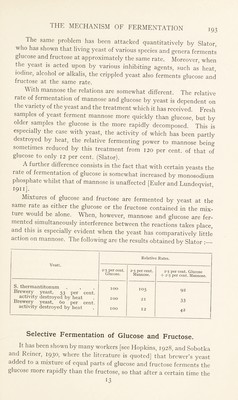
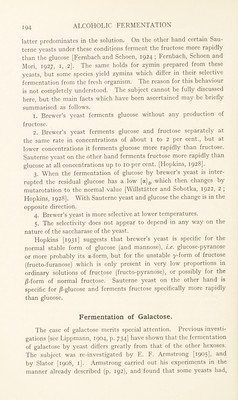
![latter predominates in the solution. On the other hand certain Sau- terne yeasts under these conditions ferment the fructose more rapidly than the glucose [Fernbach and Schoen, 1924 ; Fernbach, Schoen and Mori, 1927, I, 2]. The same holds for zymin prepared from these yeasts, but some species yield zymins which differ in their selective fermentation from the fresh organism. The reason for this behaviour is not completely understood. The subject cannot be fully discussed here, but the main facts which have been ascertained may be briefly summarised as follows. 1. Brewer’s yeast ferments glucose without any production of fructose. 2. Brewer’s yeast ferments glucose and fructose separately at the same rate in concentrations of about I to 2 per cent., but at lower concentrations it ferments glucose more rapidly than fructose. Sauterne yeast on the other hand ferments fructose more rapidly than glucose at all concentrations up to 10 per cent. [Hopkins, 1928]. 3. When the fermentation of glucose by brewer’s yeast is inter- rupted the residual glucose has a low [a]D which then changes by mutarotation to the normal value [\\ illstatter and Sobotka, I922> 2 > Hopkins, 1928]. With Sauterne yeast and glucose the change is in the opposite direction. 4. Brewer’s yeast is more selective at lower temperatures. 5. The selectivity does not appear to depend in any way on the nature of the saccharase of the yeast. Hopkins [1931] suggests that brewer’s yeast is specific for the normal stable form of glucose (and mannose), i.e. glucose-pyranose or more probably its a-form, but for the unstable y-form of fructose (fructo-furanose) which is only present in very low proportions in ordinary solutions of fructose (fructo-pyranose), or possibly for the /3-form of normal fructose. Sauterne yeast on the other hand is specific for ^-glucose and ferments fructose specifically more rapidly than glucose. Fermentation of Galactose. The case of galactose merits special attention. Previous investi- gations [see Lippmann, 1904, p. 734] have shown that the fermentation of galactose by yeast differs greatly from that of the other hexoses. The subject was re-investigated by E. F. Armstrong [1905], and by S'lator [1908, 1]. Armstrong carried out his experiments in the manner already described (p. 192), and found that some yeasts had,](https://iiif.wellcomecollection.org/image/b29808765_0204.jp2/full/800%2C/0/default.jpg)
 No text description is available for this image
 No text description is available for this image
 No text description is available for this image