Licence: In copyright
Credit: Alcoholic fermentation / by Arthur Harden. Source: Wellcome Collection.
62/258 page 52
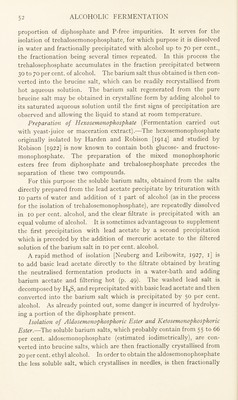
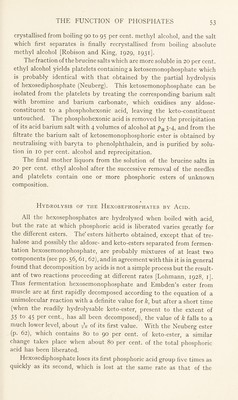
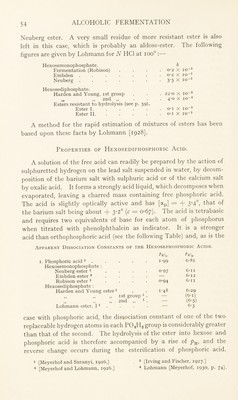
![proportion of diphosphate and P-free impurities. It serves for the isolation of trehalosemonophosphate, for which purpose it is dissolved in water and fractionally precipitated with alcohol up to 70 per cent., the fractionation being several times repeated. In this process the trehalosephosphate accumulates in the fraction precipitated between 30 to 70 per cent, of alcohol. The barium salt thus obtained is then con- verted into the brucine salt, which can be readily recrystallised from hot aqueous solution. The barium salt regenerated from the pure brucine salt may be obtained in crystalline form by adding alcohol to its saturated aqueous solution until the first signs of precipitation are observed and allowing the liquid to stand at room temperature. Preparation of Hexosemonophosphate (Fermentation carried out with yeast-juice or maceration extract).—The hexosemonophosphate originally isolated by Harden and Robison [1914] and studied by Robison [1922] is now known to contain both glucose- and fructose- monophosphate. The preparation of the mixed monophosphoric esters free from diphosphate and trehalosephosphate precedes the separation of these two compounds. For this purpose the soluble barium salts, obtained from the salts directly prepared from the lead acetate precipitate by trituration with 10 parts of water and addition of 1 part of alcohol (as in the process for the isolation of trehalosemonophosphate), are repeatedly dissolved in 10 per cent, alcohol, and the clear filtrate is precipitated with an equal volume of alcohol. It is sometimes advantageous to supplement the first precipitation with lead acetate by a second precipitation which is preceded by the addition of mercuric acetate to the filtered solution of the barium salt in 10 per cent, alcohol. A rapid method of isolation [Neuberg and Leibowitz, 1927, 1] is to add basic lead acetate directly to the filtrate obtained by heating the neutralised fermentation products in a water-bath and adding barium acetate and filtering hot (p. 49). The washed lead salt is decomposed by H2S, and reprecipitated with basic lead acetate and then converted into the barium salt which is precipitated by 50 per cent, alcohol. As already pointed out, some danger is incurred of hydrolys- ing a portion of the diphosphate present. Isolation of Aldosemonophosphoric Ester and Ketosemonophosphoric Ester.—The soluble barium salts, which probably contain from 55 to 66 per cent, aldosemonophosphate (estimated iodimetrically), are con- verted into brucine salts, which are then fractionally crystallised from 20 per cent, ethyl alcohol. In order to obtain the aldosemonophosphate the less soluble salt, which crystallises in needles, is then fractionally](https://iiif.wellcomecollection.org/image/b29808765_0062.jp2/full/800%2C/0/default.jpg)
 No text description is available for this image
 No text description is available for this image
 No text description is available for this image