Licence: In copyright
Credit: Alcoholic fermentation / by Arthur Harden. Source: Wellcome Collection.
64/258 page 54
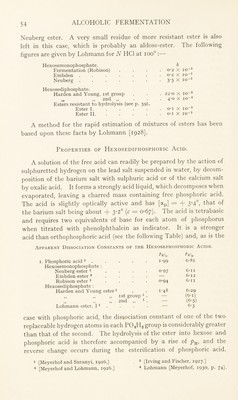
![Neuberg ester. A very small residue of more resistant ester is also left in this case, which is probably an aldose-ester. The following figures are given by Lohmann for N HC1 at 100° :— Hexosemonophosphate. Fermentation (Robison) Embden ...... Neuberg ...... Hexosediphosphate. Harden and Young, ist group it >> 2nd ,, • Esters resistant to hydrolysis (see p. 59). Ester I. Ester II. k 0-2 X IO~3 0-2 X IO-3 3'5 x IO3 22-0 X IO“3 4-0 x 10-3 O’l X IO-3 O-I X IO3 A method for the rapid estimation of mixtures of esters has been based upon these facts by Lohmann [1928]. Properties of Hexosediphosphoric Acid. A solution of the free acid can readily be prepared by the action of sulphuretted hydrogen on the lead salt suspended in water, by decom- position of the barium salt with sulphuric acid or of the calcium salt by oxalic acid. It forms a strongly acid liquid, which decomposes when evaporated, leaving a charred mass containing free phosphoric acid. The acid is slightly optically active and has [aD] = + 3-4°, that of the barium salt being about + 3-2° (c = 0-67). The acid is tetrabasic and requires two equivalents of base for each atom of phosphorus when titrated with phenolphthalein as indicator. It is a stronger acid than orthophosphoric acid (see the following Table) and, as is the Apparent Dissociation Constants of the Hexosephosphoric Acids. 1. Pk\. Phosphoric acid 1 . 1-99 6-8i Hexosemonophosphate : Neuberg ester 2 0-97 tell Embden ester 3 — 6-12 Robison ester 3 o-94 6-n Hexosediphosphate : Harden and Young ester1 1-40 0-29 „ ,, 1 st group 1 . — (6-i) ,, ,, „ 2nd ,, 1 . — (6-5) Lohmann ester, I 4 — 6’3 th phosphoric acid, the dissociation constant of one of the two replaceable hydrogen atoms in each P04H2 group is considerably greater than that of the second. The hydrolysis of the ester into hexose and phosphoric acid is therefore accompanied by a rise of pH, and the reverse change occurs during the esterification of phosphoric acid. 1 [Meyerhof and Suranyi, 1926.] . 2 [Irving and Fischer, 1927.] 3 [Meyerhof and Lohmann, 1926.] 4 Lohmann [Meyerhof, 193°. P- 74]*](https://iiif.wellcomecollection.org/image/b29808765_0064.jp2/full/800%2C/0/default.jpg)
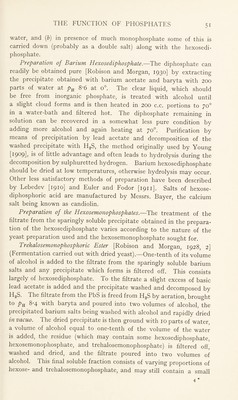
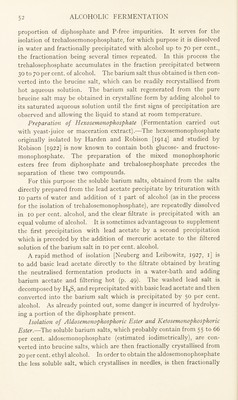
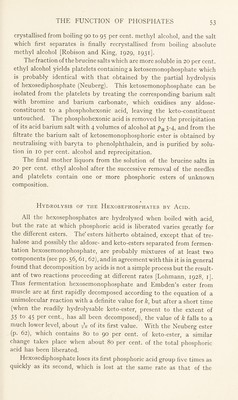
 No text description is available for this image
 No text description is available for this image
 No text description is available for this image