Licence: In copyright
Credit: Alcoholic fermentation / by Arthur Harden. Source: Wellcome Collection.
70/258 page 60
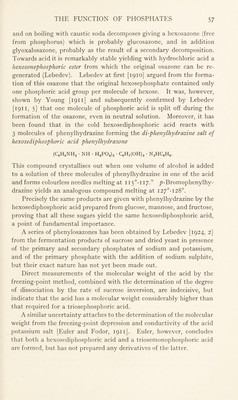
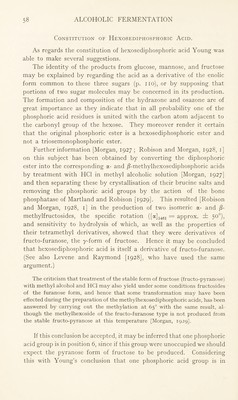
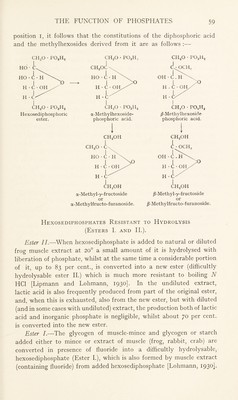
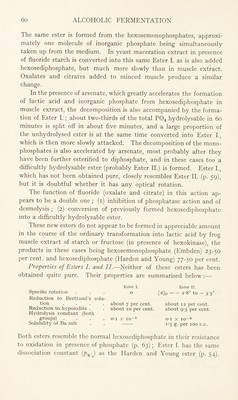
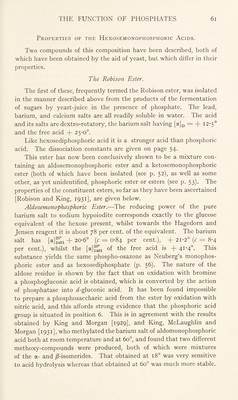
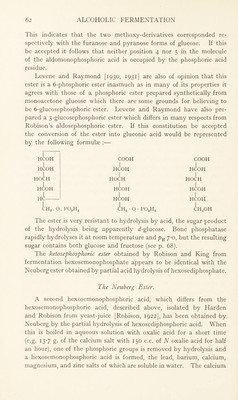
![The same ester is formed from the hexosemonophosphates, approxi- mately one molecule of inorganic phosphate being simultaneously taken up from the medium. In yeast maceration extract in presence of fluoride starch is converted into this same Ester I. as is also added hexosediphosphate, but much more slowly than in muscle extract. Oxalates and citrates added to minced muscle produce a similar change. In the presence of arsenate, which greatly accelerates the formation of lactic acid and inorganic phosphate from hexosediphosphate in muscle extract, the decomposition is also accompanied by the forma- tion of Ester I.; about two-thirds of the total P04 hydrolysable in 60 minutes is split off in about five minutes, and a large proportion of the unhydrolysed ester is at the same time converted into Ester I., which is then more slowly attacked. The decomposition of the mono- phosphates is also accelerated by arsenate, most probably after they have been further esterified to diphosphate, and in these cases too a difficultly hydrolysable ester (probably Ester II.) is formed. Ester I., which has not been obtained pure, closely resembles Ester II. (p. 59), but it is doubtful whether it has any optical rotation. The function of fluoride (oxalate and citrate) in this action ap- pears to be a double one ; (1) inhibition of phosphatase action and of desmolysis ; (2) conversion of previously formed hexosediphosphate into a difficultly hydrolysable ester. These new esters do not appear to be formed in appreciable amount in the course of the ordinary transformation into lactic acid by frog muscle extract of starch or fructose (in presence of hexokinase), the products in these cases being hexosemonophosphate (Embden) 23-50 per cent, and hexosediphosphate (Harden and Young) 77-50 per cent. Properties of Esters I. and II.—Neither of these esters has been obtained quite pure. Their properties are summarised below:— Specific rotation Reduction to Bertrand’s tion Reduction to hypoiodite . Hydrolysis constant (both groups) Solubility of Ba salt Ester I. . O solu- about 7 per cent, about 10 per cent. o-i x io~3 Ester II. [a]D = _ 2-8° to - 3-5 about 12 per cent, about 9-5 per cent. o-i x io~3 i*5 g. per 100 c.c. Both esters resemble the normal hexosediphosphate in their resistance to oxidation in presence of phosphate (p. 63); Ester I. has the same dissociation constant (pK>) as the Harden and Young ester (p. 54).](https://iiif.wellcomecollection.org/image/b29808765_0070.jp2/full/800%2C/0/default.jpg)
 No text description is available for this image
 No text description is available for this image
 No text description is available for this image