Licence: In copyright
Credit: Alcoholic fermentation / by Arthur Harden. Source: Wellcome Collection.
72/258 page 62
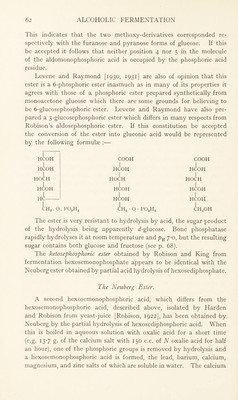
![This indicates that the two methoxy-derivatives corresponded re- spectively with the furanose and pyranose forms of glucose. If this be accepted it follows that neither position 4 nor 5 in the molecule of the aldomonophosphoric acid is occupied by the phosphoric acid residue. Levene and Raymond [1930, 1931] are also of opinion that this ester is a 6-phosphoric ester inasmuch as in many of its properties it agrees with those of a phosphoric ester prepared synthetically from monoacetone glucose which there are some grounds for believing to be 6-glucosephosphoric ester. Levene and Raymond have also pre- pared a 3-glucosephosphoric ester which differs in many respects from Robison’s aldosephosphoric ester. If this constitution be accepted the conversion of the ester into gluconic acid would be represented by the following formulae HCOH COOH COOH HCOH | HCOH 1 HCOH HOCH HOCH J HOCH I | HCOH 1 HCOH 1 HCOH 1 HC HCOH | HCOH I ch2.0 . P03H2 | ch2 • 0 • po3h2 ch2oh The ester is very resistant to hydrolysis by acid, the sugar product of the hydrolysis being apparently ^-glucose. Bone phosphatase rapidly hydrolyses it at room temperature and pK 7-0, but the resulting sugar contains both glucose and fructose (see p. 68). The ketosephosphoric ester obtained by Robison and King from fermentation hexosemonophosphate appears to be identical with the Neuberg ester obtained by partial acid hydrolysis of hexosediphosphate. The Neuberg Ester. A second hexosemonophosphoric acid, which differs from the hexosemonophosphoric acid, described above, isolated by Harden and Robison from yeast-juice [Robison, 1922], has been obtained by Neuberg by the partial hydrolysis of hexosediphosphoric acid. When this is boiled in aqueous solution with oxalic acid for a short time (e.g. 13-7 g. of the calcium salt with 150 c.c. of N oxalic acid for half an hour), one of the phosphoric groups is removed by hydrolysis and a hexosemonophosphoric acid is formed, the lead, barium, calcium, magnesium, and zinc salts of which are soluble in water. The calcium](https://iiif.wellcomecollection.org/image/b29808765_0072.jp2/full/800%2C/0/default.jpg)
 No text description is available for this image
 No text description is available for this image
 No text description is available for this image