Licence: In copyright
Credit: Alcoholic fermentation / by Arthur Harden. Source: Wellcome Collection.
81/258 page 71
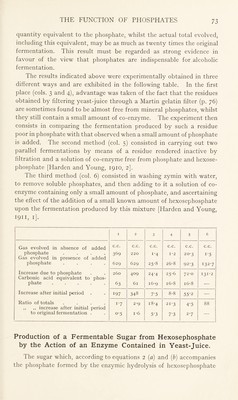
![the highest rate attained represents the maximum velocity at which reactions I (a) and (b) can proceed in that sample of yeast-juice or zymin, and this high rate is characteristic of the initial period of accelerated fermentation which follows the addition of a suitable quantity of phos- phate. By the simple expedient of renewing the supply of phosphate as rapidly as it is converted into hexosephosphate, this high rate can be maintained for a considerable time [Harden and Young, 1908, 1]. In this way, for example, an average rate of evolution of carbon dioxide of 15 c.c. in five minutes was maintained for an hour and a quarter, whereas the normal rate in the absence of added phosphate was 3 c.c. As soon as all the free phosphate has entered into the reaction, however, the supply of phosphate depends in the main on the rate at which the resulting hexosephosphate is decomposed, and the rate of fermentation now attained is conditioned by the rate at which re- actions 2a, 2b, and 2c proceed. The rates attained during the initial period of rapid fermentation and the subsequent period of slow fermentation are thus seen to represent the velocities of entirely different chemical reactions. These considerations also explain why it is the extra carbon dioxide evolved during the initial period, and not the total carbon dioxide, which is equivalent to the added phosphate. As the production of phosphate is proceeding throughout the whole period it is obviously necessary to deduct the corresponding amount of carbon dioxide from the total evolved in order to ascertain the amount equivalent to the added phosphate. Some uncertainty exists as to the amount of this correction, for the rate of decomposition of hexosephosphate may be (a) checked by the presence of inorganic phosphate, (b) increased by the presence of an increased concentration of hexosephosphate. An explanation is also afforded of the fact that a considerable increase in the concentration of hexosephosphate does not materially increase the normal rate of fermentation by yeast-juice. This is probably due to the circumstance that, in accordance with the gen- eral behaviour of enzymes in presence of excess of the fermentable substance, approximately equal amounts of hexosephosphate are decomposed in equal times whatever its concentration may be, above a certain limit which for yeast-juice is generally low. With dried yeast and zymin, which are relatively rich in the enzymes which decompose hexosephosphate, the normal or basal rate is at first considerably increased when the concentration of](https://iiif.wellcomecollection.org/image/b29808765_0081.jp2/full/800%2C/0/default.jpg)
 No text description is available for this image
 No text description is available for this image
 No text description is available for this image