Licence: In copyright
Credit: Alcoholic fermentation / by Arthur Harden. Source: Wellcome Collection.
90/258 page 80
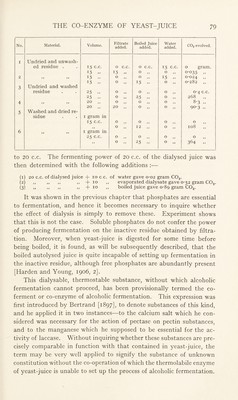
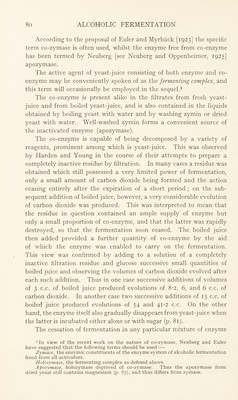
![According to the proposal of Euler and Myrback [1923] the specific term co-zymase is often used, whilst the enzyme free from co-enzyme has been termed by Neuberg [see Neuberg and Oppenheimer, 1925] apozymase. The active agent of yeast-juice consisting of both enzyme and co- enzyme may be conveniently spoken of as the fermenting complex, and this term will occasionally be employed in the sequel.1 The co-enzyme is present alike in the filtrates from fresh yeast- juice and from boiled yeast-juice, and is also contained in the liquids obtained by boiling yeast with water and by washing zymin or dried yeast with water. Well-washed zymin forms a convenient source of the inactivated enzyme (apozymase). The co-enzyme is capable of being decomposed by a variety of reagents, prominent among which is yeast-juice. This was observed by Harden and Young in the course of their attempts to prepare a completely inactive residue by filtration. In many cases a residue was obtained which still possessed a very limited power of fermentation, only a small amount of carbon dioxide being formed and the action ceasing entirely after the expiration of a short period ; on the sub- sequent addition of boiled juice, however, a very considerable evolution of carbon dioxide was produced. This was interpreted to mean that the residue in question contained an ample supply of enzyme but only a small proportion of co-enzyme, and that the latter was rapidly destroyed, so that the fermentation soon ceased. The boiled juice then added provided a further quantity of co-enzyme by the aid of which the enzyme was enabled to carry on the fermentation. This view was confirmed by adding to a solution of a completely inactive filtration residue and glucose successive small quantities of boiled juice and observing the volumes of carbon dioxide evolved after each such addition. Thus in one case successive additions of volumes of 3 c.c. of boiled juice produced evolutions of 8*2, 6, and 6 c.c. of carbon dioxide. In another case two successive additions of 15 c.c. of boiled juice produced evolutions of 54 and 41-2 c.c. On the other hand, the enzyme itself also gradually disappears from yeast-juice when the latter is incubated either alone or with sugar (p. 81). The cessation of fermentation in any particular mixture of enzyme 1 In view of the recent work on the nature of co-zymase, Neuberg and Euler have suggested that the following terms should be used:— Zymase, the enzymic constituents of the enzyme system of alcoholic fermentation freed from all activators. Holozymase, the fermenting complex as defined above. Apozymase, holozymase deprived of co-zymase. Thus the apozymase from dried yeast still contains magnesium (p. 87), and thus differs from zymase.](https://iiif.wellcomecollection.org/image/b29808765_0090.jp2/full/800%2C/0/default.jpg)
 No text description is available for this image
 No text description is available for this image
 No text description is available for this image