The Bhagavat-Geeta, or dialogues of Krishna and Arjoon ... Sanscrit, Canarese, and English ... / The Sanscrit text from Schlegel's edition ; the Canarese newly translated from the Sanscrit ; the English translation by Sir C. Wilkins, with his preface and notes ... and the introduction, by ... Warren Hastings ... With ... additional notes from Prof. Wilson, Rev. H. Milman, etc. ; and an Essay ... by Baron W. von Humboldt, translated ... by ... G.H. Weigle : the second ed. of Schlegel's Latin version ... with the Sanscrit text revised by Prof. Lassen, etc. Edited by ... J. Garrett.
- Date:
- 1849
Licence: Public Domain Mark
Credit: The Bhagavat-Geeta, or dialogues of Krishna and Arjoon ... Sanscrit, Canarese, and English ... / The Sanscrit text from Schlegel's edition ; the Canarese newly translated from the Sanscrit ; the English translation by Sir C. Wilkins, with his preface and notes ... and the introduction, by ... Warren Hastings ... With ... additional notes from Prof. Wilson, Rev. H. Milman, etc. ; and an Essay ... by Baron W. von Humboldt, translated ... by ... G.H. Weigle : the second ed. of Schlegel's Latin version ... with the Sanscrit text revised by Prof. Lassen, etc. Edited by ... J. Garrett. Source: Wellcome Collection.
42/268 (page 16)
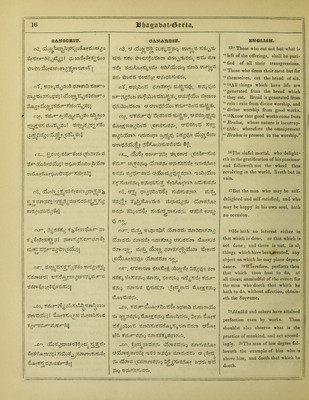
![SAN3CRST. o3. f &osi§£i&S&o •^•^rsjSopw^-osxi^^gs'df'S'si' || otf. tj&f-o jTDjj-rfo^o^g I odo^TS^S^aiF-0 ^js^^oSo^S^p-To^'rf^Sll > o^. tfdb^^soJB^zS^io a&^&jo 55^j£tf?o siwT^tSo I \^^p^oc6o^[^>Blx^c\\ oa_, ^o'rfj'rfSr&o8j ^o^js^o ^ ^F~cjSoa^a5ogl es^o^Oo&o^aira uD^.e^oe^^o^rs^F-ro2§^§H o3. 3TS^i° | s’wd^o^St^^l] O-J—. f^3oo£ £ I ^Ea'aTojjrfcF-^^? SA^Z^p-^'tra^soi>° n OS~, ^ots^'rfru^rO^^O ffS’d^’o'Shjj ■ddOelT^p^^ao)^^?! ^rezSccbg I €j®^7io\?(z6 -^o^briot) = VtdiF~ odoStF- rvjj _co. oioij^CTsed'-dSo;^ Tj^tS? ■So^-cU^SS^gl ©Jti^ro T^o^eF-^® CANA3RESE. o3 c? 6!>oaiz5'!) enirso-rf ro^vzb rs m * o ^ f® ^ ^db Tv^ •^DdA^o'rf^ra £3d;y N^dfd^ ©rfo dcrs ^sdj/^jsj^^d^o esa^o^)1^ djsa 3tb ^roti-rf ^etrf;3^ es^o^SAGd-do. otf. es^&ozS gire^A^o e?^^jT> &JF-oib^c&oozSjcoK^:^ tS^^TaaD t^c&ioTSeo® e? eJu®z£3c&*> ^dop-^oTj 5&&^>. eJ^sdoF-^) z3^b oxd 5co^»oi tStteoisS^ ^js^croaj^aoxd ^jSFgTood^b, eFEftfoolS '^‘djdoqrs a^a^j o&z^ozs eytjs^dfojj^ ^^JSo&db^-zSoTi» 3$. a£_, o3o€^ ©a^F-^^ ^tJsD-d (Tte!lF~r&3 vSk)r~ c5ijDd^o ©^oiSTj^ csrdb^JS^ esx^o d^^p-ro-rf ^o&jako a^ AOSOd^ Sf>8,dSdrda^ aoTk^o^o °8. e?^ j^3^£>ot3<6$> Tfcs&T&tS^'ft Tdo^ a^^wjsoTjod o^js-rf^ja^ esd^jj ajb^ oz^p Tdo^jx^-TDAod^j su-rf^ rh f^«y co’ oo , &>x)a^ Sf-Ocjr^d^/^ d3o.^'dToo daeJuico^AGa^^ O^J^dTdo djaid^ r£;o®AJ3^ e?AjdZdje) SoJS^AJd z5js (^ai doao oSoero gjjs^Afdl) o^oj® iSpssTd co’ —° co °eo v rT$o3ojsp8tf^ip airo^zSja) me; v co’ OS-. tfTto-df® ^eret^g* cOootS^ dra ds^ ^d^)^ dJsTi>5 ^d-^ ^doF- d^db^ dja)vjOd ^jdosd^'^ ^3^T>_Cjo lJ o3ja)^g^o5^b^ zousgZ^o .5 , -Go, sdoF-dSajs^A&otd^^ dos^uDdlb tfc a^Fcdd^d^ ^oJscSi ujdo^ ^p^oo zdT?^o5oozd djsjarojdxd^js^rd^dGitiddJi) si-rJ ^doF-d^ djada^d^)7\oD, _Do. -ij^d^stTdd-^o crfjBdzd^ d^radod^j?)^ eJd^JeJd^’^dd^ <^dd djsdoddo ey ^d Cy^Jcid ^ddjalpsd^do^ pb^^Tvod^Je;^ 2F^ddo Cf)d ^ es^drjBT&ddj. ENGLISH. . l3“ Those who eat not but what is “ left of the offerings, shall be puri- “ fied of all their transgressions. “ Those who dress their meat but for “ themselves, eat the bread of sin. “ 14A11 things which have life are “generated from the bread which “ they eat. Bread is generated from “ rain : rain from divine worship, and “ divine worship from good works. “ 15Know that good works come from “ Brahm, whose nature is incorrup- “ tible ; wherefore the omnipresent “ Brahm is present in the worship.” 16The sinful mortal, who delight- eth in the gratification of his passions’ and followeth not the wheel, thus revolving in the world, liveth but in vain. i7But the man who may be self- delighted and self satisfied, and who may be happy in his own soul, hath no occasion. 18He hath no interest either in that which is done, or that which is not done ; and there is not, in alj things which have been^ereated, any object on which he may place depen- dance. l9WTierefore, perform thou that which thou hast to do, at all times; unmindful of the event; for the man who doeth that which he hath to do, without affection, obtain- eth the Supreme. 2oJanaka and others have attained perfection e\eu by works. Thou shouldst also observe what is the practice of mankind, and act accord- ingly. 2iThe man of low degree fol- loweth the example of him who is above him, and doeth that which he doeth.](https://iiif.wellcomecollection.org/image/b22007209_0042.jp2/full/800%2C/0/default.jpg)