Volume 1
Descriptive and illustrated catalogue of the physiological series of comparative anatomy contained in the Museum of the Royal College of Surgeons in London / [By R. Owen].
- Royal College of Surgeons of England. Museum
- Date:
- 1833-40
Licence: Public Domain Mark
Credit: Descriptive and illustrated catalogue of the physiological series of comparative anatomy contained in the Museum of the Royal College of Surgeons in London / [By R. Owen]. Source: Wellcome Collection.
33/320 page 13
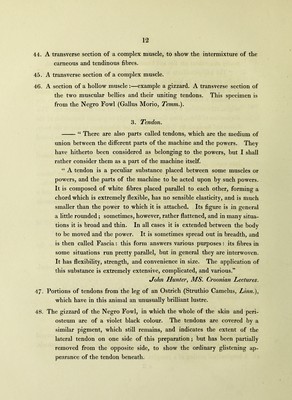
![49. A tendon from the leg of a Calf, injected, dried, and put into oil of turpen- tine, to show its small degree of vascularity. 49 a. The tendo Achillis, injected, with part of the gastrocnemius muscle, to show by contrast the difference in the vascularity of these parts. Donor, Sir William Blizard. Series V. Application of Muscles. In the most imperfect [or simplest] animals it is very probable that there is no difference in the structure of parts [of the body] ; no fixed parts, so as to divide and determine the motion of the animal to those parts, similar to bones in others; but that the whole is principally mus- cular, like the urinary bladder, or an intestine. But where animals become more complicated, and have various motions, especially progressive, then the motions become more divided, more partial; for which purpose it is necessary that there should be parts, whose firmness of structure and mode of attachment should divide these motions and determine them to the particular parts. This structure is different, in different animals : in the caterpillar, the earthworm, the nereis, this structure is the skin: it is divided into rings, all of which have motion on each other, and into each are muscles in- serted, so that a variety of motions are produced. If the whole act, the animal is shortened; if the whole from end to end act only on one side, the animal is bent; but if a succession of motions from one end to the other takes place, then progressive motion is produced. In the insect, when arrived at its perfect state ; in the lobster, spider, &c., whose parts are still more complicated, and answering a greater variety of purposes, we find this substance still firmer, and of different texture: thus in the flying insect and spider, it is horn; in the lobster, &c. it is bone. In them, too, it makes the covering of the animal; but besides these, there are processes going inwards for the attachment of muscles.](https://iiif.wellcomecollection.org/image/b22007763_0001_0033.jp2/full/800%2C/0/default.jpg)



 No text description is available for this image
 No text description is available for this image
 No text description is available for this image