Rudiments of animal physiology : for use in schools, and for private instruction / by G. Hamilton.
- Hamilton, George, 1808-1885
- Date:
- 1839
Licence: Public Domain Mark
Credit: Rudiments of animal physiology : for use in schools, and for private instruction / by G. Hamilton. Source: Wellcome Collection.
Provider: This material has been provided by the Francis A. Countway Library of Medicine, through the Medical Heritage Library. The original may be consulted at the Francis A. Countway Library of Medicine, Harvard Medical School.
88/116 page 82
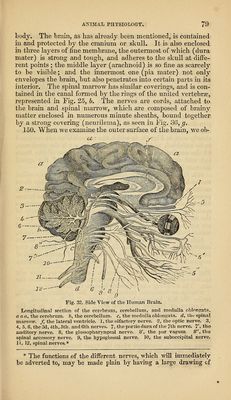
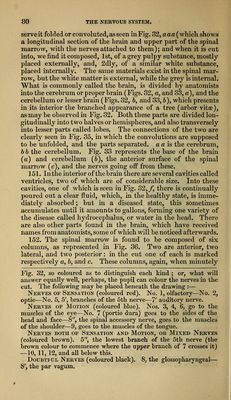
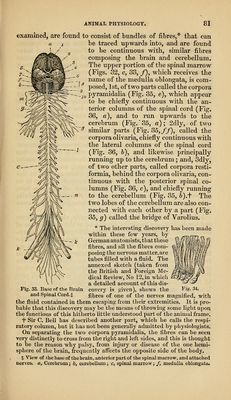
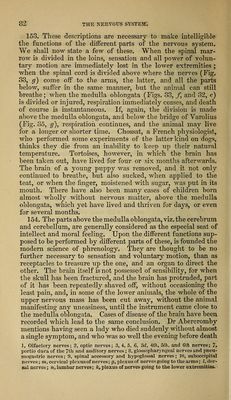
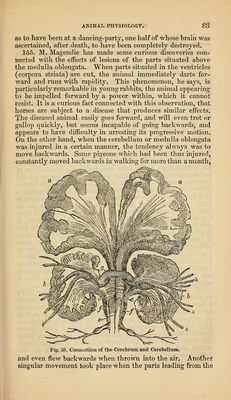
![158. These descriptions are necessary to make intelligible the functions of the different parts of the nervous system. We shall now state a few of these. When the spinal mar- row is divided in the loins, sensation and all power of volun- tary motion are immediately lost in the lower extremities ; when the spinal cord is divided above where the nerves (Fig. S3, g) come off to the arms, the latter, and all the parts below, suffer in the same manner, but the animal can still breathe; w^hen the medulla oblongata (Figs. 83, /, and 32, c) is divided or injured, respiration immediately ceases, and death of course is instantaneous. If, again, the division is made above the medulla oblongata, and below the bridge of Varolius (Fig. 35, g)^ respiration continues, and the animal may live lor a longer or shorter time. Chossat, a French physiologist, who performed some experiments of the latter kind on dogs, thinks they die from an inability to keep up their natural temperature. Tortoises, however, in which the brain has been taken out, have lived for four or six months afterwards. The brain of a young puppy v/as removed, and it not only continued to breathe, but also sucked, when applied to the teat, or when the finger, moistened with sugar, was put in its mouth. There have also been many cases of children born almost wholly without nervous matter, above the medulla oblongata, which yet have lived and thriven for days, or even for several months. 154. The parts above the medulla oblongata, viz. the cerebrum and cerebellum, are generally considered as the especial seat of intellect and moral feeling. Upon the different functions sup- posed to be performed by different parts of these, is founded the modern science of phrenology. They are thought to be no further necessary to sensation and voluntary motion, than as receptacles to treasure up the one, and an organ to direct the other. The brain itself is not possessed of sensibility, for when the skull has been fractured, and the brain has protruded, part of it has been repeatedly shaved off, without occasioning the least pain, and, m some of the lower animals, the whole of the upper nervous mass has been cut away, without the animal manifesting any uneasiness, until the instrument came close to the medulla oblongata. Cases of disease of the brain have been recorded which lead to the same conclusion. Dr Abercromby mentions having seen a lady who died suddenly withoiit almost a single symptom, and who was so well the evening before death ], Olfactory nerves; 2, optic nerves; 3, 4, 5, 6, 2d, 4th, 5th, and 6ih nerves; 7. portio dura of the 7tli and auditory nerves ; 8, glossopharyngeal nerves and pneu- mogastric nerves; 9, spinal accessory and hypoglossal nerves; 10, suboccipital nerves; m, cervical plexus of nerves; g, plexus of nerves going to the arms; I, dor- sal nerves; n, lumbar nerves; k, plexus of nerves going to the lower extremities.](https://iiif.wellcomecollection.org/image/b21056766_0088.jp2/full/800%2C/0/default.jpg)
 No text description is available for this image
 No text description is available for this image
 No text description is available for this image