Nervous diseases : their description and treatment / by Allan McLane Hamilton.
- Allan McLane Hamilton
- Date:
- 1878
Licence: Public Domain Mark
Credit: Nervous diseases : their description and treatment / by Allan McLane Hamilton. Source: Wellcome Collection.
488/540 (page 488)
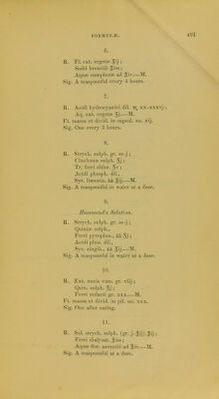
![Prognosis—If tlie individual gives up tlio occupation wliich lias pro- duced the ailccl ioM, there is no reason why ho siiould not recover, provided the disease has not become conlinned, and evfui in this form Jaccoud' speaks of a rare temporary amelioration. It luis been my experience that, if taken in hand promptly, the patient may be cured. Sixteen of these cases were absolutely cured, and continued so lus long ius they refrained from their work. Two were improved, but upon beginning the pursuit of their calling had relapses. The remainder were of the paralytic variety, and are now under treatment. Treatment—Rest and electricity are the means at our command. A galvanic current is found to be the most beneficial, and the electrodes should be so small as to include but one muscle at a time in the circuit. The current must be mild, or it will only aggravate the disease. Besides this application to special muscles, one pole may be placed at the nape of the neck, and the other to the muscles of the hand and forearm. A. W., aged 38. The patient had followed the occupation of clerk for several years, and had assiduously woi-ked at his desk for many hours in the day. Two weeks before I saw him he noticed an impairment in his writing power, and this consisted in an inability to write without the occurrence of a convulsive contraction of the extensors of his riffht forearm, by which the ])en flew from the [)aper. This did not occur at the moment of writing, but after a few words hatl been finished. He tried to keep the hand steady by the influence of the will, but all his, efforts were ineffectual. When he attempted to hold the point of any small ob- ject, such as a stick or pencil, against the surface, the same spasm would occur. There was no wasting of the muscles, pain, or other sym])tom. I determined to try g-alvanism combined with manual exercise, and the internal application of strychnia in doses of 55th of a grain. Galvaniza- tion of the flexors of the forearm and of the small muscles of the hand was made, and, at the same time, the positive pole was held for a few minutes at the nape of the neck. He was directed to procure the i-ound of a chair with which to exercise. Galvanization wiis persevered in, although the progress was very slow. At fii-st he could not write more than two words (almost illegibly) ; but as he grew better, these spa»'?ms disappeared. Three seances a week ke[)t up for a period of about three months effected such an improved condition that he was finally dischiU'ged at the end of that time. Strychnia and iron, or conium (FF. 8, 9, 10, 48, 51, 72, 82), are remedies which may be used in conjunction. The ether spray apparatus does great good, and I have occasionally benefited my patients by fasten- ing the hand in an immovable ai)[)aratus or splint. Absolute cessation of the particular work 'v\'hich gave rise to the malady is to he insisted upon, and no benefit will result from any form of treatment unless this command of the physician is respected. When the patient attempts writing anew he should provide himself Avith a pen having a cork holder, and this may be pnrchiised from any](https://iiif.wellcomecollection.org/image/b21497771_0488.jp2/full/800%2C/0/default.jpg)