The detection of colour-blindness and imperfect eyesight : with a table of coloured Berlin wools and sheet of test-types / by Charles Roberts.
- Roberts, Charles, 1836-1901.
- Date:
- 1884
Licence: Public Domain Mark
Credit: The detection of colour-blindness and imperfect eyesight : with a table of coloured Berlin wools and sheet of test-types / by Charles Roberts. Source: Wellcome Collection.
Provider: This material has been provided by The University of Leeds Library. The original may be consulted at The University of Leeds Library.
15/26 page 11
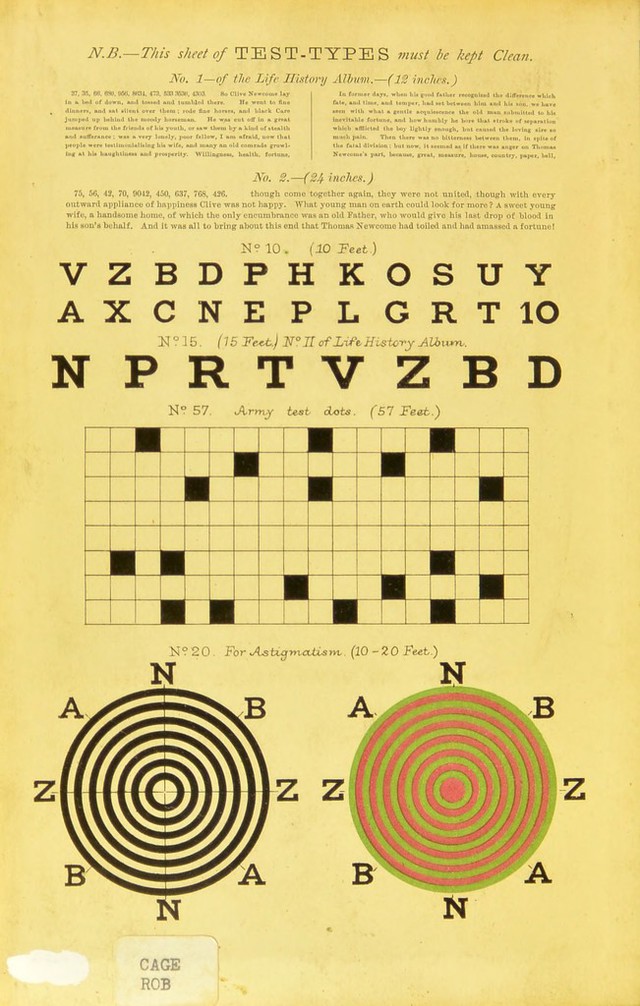
![INSTKUCTIONS FOE THE DETECTION OF IMPERFECT EYESIGHT. (See the sheet of Test-types on the cover.) 0 As a standard of vision tve adopt clear and accurate p)erce])tion, not uncertain recognition, of the test-types. Each eye should be examined separately. To determine the aciiteness of vision we measure the smallest angle at which objects of known size and known form are distinguished. To determine the visual angle we measure the extreme distance at which objects of definite size (e. g. letters) can be recognised; or we measure the size of the objects wliicli can be distinguished when placed at a definite distance [e.g. one foot). Square letters, whose limbs have a width equal to one-fifth of the letter's height, are generally distinctly- visible to a noi-mal eye at an angle of five minutes {i. e. one-twelfth of a degi-ee). The nearest point of distinct vision is from four to seven inches; the farthest point is infinite distance. The numbers placed at the head of each set of types and diagrams express the distance in feet at which they can be seen by the normal eye (i. e. at an angle of five minutes). Test I.—The test-types must be placed in the perpendicular position in good daylight, the light coming frord behind or either side of the candidate. When the small test-types are used, the card should be held by the candidate at the farthest distance at which he can read or spell the letters with the greatest fluency. The distance between the card and the eye should be measured with a rule or measuring-tape. Test II.—When the large test-types, test-dots, or diagrams composed of parallel lines are used, the card should be suspended on the wall, and a tape marked in feet laid on the ground. The candidate should be placed at a distance greater than that indicated by the numbers at the head of the type, and gradually advanced towards the card until he can clearly distinguish each letter or dot. His distance from the types will be shown by the tape at his feet.](https://iiif.wellcomecollection.org/image/b21513739_0015.jp2/full/800%2C/0/default.jpg)


 No text description is available for this image
 No text description is available for this image
 No text description is available for this image