Content advisory
This digitised material is free to access, but contains information or visuals that may:
- include personal details of living individuals
- be upsetting or distressing
- be explicit or graphic
- include objects and images of objects decontextualised in a way that is offensive to the originating culture.
Licence: In copyright
Credit: Dissertation in Draft: Chapter II. Source: Wellcome Collection.
3/9
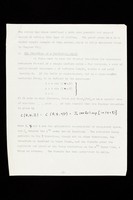
![The writer has since developed a much more por/erful and general method of solving this type of problem. The proof given here is a rather simple example of this method, which is fully described later in Chapter VII. 2. THE TRANSFORM OP A CONTINUOUS HEIIX We first need to know the Fourier transform (or continuous structure factor) of a single uniform helix - for instance, a wire of infinitesimal thickness » of infinite length, radius r and axiáL spacing P. If the helix is right-handed, and in a right-handed cartesian frame, it is defined by the equations: X = r cos (2 ttz/ P) 1 y = r sin (2 - kz / P ) | z = z J It is easy to show (Cochran, Crick and Vand,1952^or as a special case of equation , parre __ of this thesis) that its Fourier transform is given by C(R,M-,Z) C --X t»xRr)e, T i>K + D] Here R, J^and Z are the cylindrical co-ordinates of reciprocal space, and J n denotes the n order Bes.-el function. The structure being periodic in the Z direction, though not in other directions, the transform is confined to layer lines, and the formula gives the amp! i tuo e and phase of the .'.—ray scattering on the n b ~ layer line, n being an integer. The formula has been normalised to unity.](https://iiif.wellcomecollection.org/image/b18185812_PP_CRI_F_1_2_0003.jp2/full/800%2C/0/default.jpg)