Silicosis in the metal mining industry : a revaluation, 1958-1961.
- United States Public Health Service
- Date:
- [1964]
Licence: Public Domain Mark
Credit: Silicosis in the metal mining industry : a revaluation, 1958-1961. Source: Wellcome Collection.
23/260 page 3
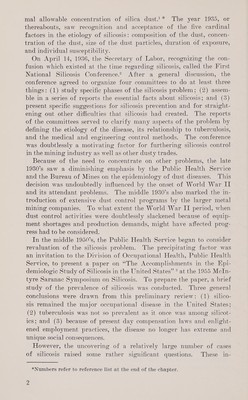
![date back to precontro] days? If so, do those cases represent pro- gression of the disease due to continued exposure to low concentra- tions of silica dust? (2) How extensive and efficient is dust control in relation to recommended standards? (8) Do our stand- ards need revision? (4) Are there other factors to which proper attention is not given, such as particle size? (5) What is the ac- tual toxicity of silica? In addition, the need was pointed up to de- vise a practical means of assessing disability, as well as to develop a satisfactory X-ray classification system. Following the McIntyre Saranac Symposium, which pointed to a serious need for current knowledge on the scope of the silicosis problem in the United States, two additional steps were taken. The first was to conduct a more extensive study of the prevalence of silicosis. By 1956, a review of compensation and other records of official agencies covering the period 1950-54 had been completed which showed that 10,362 cases of silicosis had been compensated or reported in one form or another in 22 States. This sizable sili- _cotic population was primarily an elderly group, with over 75 per- cent of the cases 50 years and older. Of 3,455 persons for whom reasonably adequate employment histories were obtained, only 10 percent allegedly received their entire dust. exposure after 1935. The total mining industry contributed two-thirds of all the cases; metal mining accounted for 24.5 percent of all the cases in the mining industry. In the manufacturing group, which accounted for 27.6 percent, the foundry industry was the largest contributor. The second step was to revaluate the silicosis problem in the eranite-cutting industry. This industry had been the subject of a detailed study by the Public Health Service in the middle 1920’s and again in the later 1930’s.°* The most striking finding of these early studies was the almost universal occurrence of silicosis among the workers exposed over 10 years to dust concentrations above 40 million particles per cubic foot of air with a 35-percent free silica content. The revaluation of the granite industry in 1956 revealed that the dust concentrations at that time were well below the recommended State standard of 10 million particles per cubic foot for granite dust. Insofar as records indicated, and within the limitations of the X-ray equipment available, not a single case of silicosis had developed in a granite-shed worker whose initial exposure followed the installa- tion of dust controls.” One cannot assume that the dust concentra- tions found in the 1956 survey were representative of those to which workers were exposed over the previous 20 years; indeed, there is evidence that dust control measures in the granite sheds, as in many other dusty industries, had deteriorated during the 8- to 10-year period influenced by World War II. The study did indicate, how- 3](https://iiif.wellcomecollection.org/image/b32183136_0023.jp2/full/800%2C/0/default.jpg)
 No text description is available for this image
 No text description is available for this image
 No text description is available for this image