Report to the secretary of state for the home department on the causes of death in colliery explosions and underground fires, with special reference to the explosions at Tylorstown, Brancepeth and Micklefield / by John Haldane.
- John Scott Haldane
- Date:
- 1896
Licence: Public Domain Mark
Credit: Report to the secretary of state for the home department on the causes of death in colliery explosions and underground fires, with special reference to the explosions at Tylorstown, Brancepeth and Micklefield / by John Haldane. Source: Wellcome Collection.
Provider: This material has been provided by London School of Hygiene & Tropical Medicine Library & Archives Service. The original may be consulted at London School of Hygiene & Tropical Medicine Library & Archives Service.
11/52 page 9
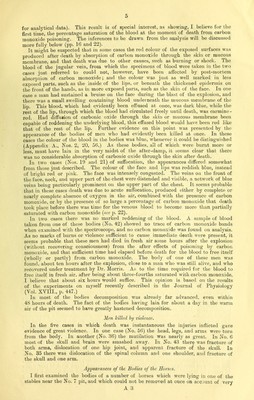
![This mixture will, under the pre-supposed conditions, be diluted with more or less of air. As it requires the presence of from 5 to 6 per cent, of fire-damp to render the air inflammable, there will not be more than 10 5 of oxygen, or 50 per cent, of pure air left in the residual gas. On the other hand, if the explosive mixture contained as much as 9'47 per cent, of fire-damp, there will be no oxygen left in the track of the explosion. The undiluted after-damp from an explosion with excess of air would have a specific gravity of 1*037. This is not much higher than that of air (l'OOO) so long as this after-damp remained more than about 9° C. or 16° F. warmer than the (pure) air in the intake roads, and correspondingly more saturated with aqueous vapour, which is lighter than air, it would tend to keep along the roof. The cooled after-damp, on the other hand, would lie along the floor, forming a layer similar to that usually observed in the case of black-damp, which has about the same specific gravity. In an actual pit explosion, it will, of course, never occur that the mixture of tire-damp and air is everywhere equable. As a rule there will be more fire-damp along the roof and less towards the floor. Moreover the air -which is mixed with the exploding fire-damp will not be pure, but will contain more or less black-damp.* To illustrate this latter point, we may suppose the explosion to occur in a return airway, and that the return air has become explosive through the fan or furnace being out of order, or insufficient to cope with the gas driven out from unventilated cavities, &c, by a sudden fall of atmospheric pressure. Now, besides fire-damp, the return air of a coal mine contains a variable proportion of black-damp. In support of this statement I may quote the following analyses of return air from pits in different districts in England and Scotland.f To render the analyses more readily intelligible, they are expressed in terms of air, black-damp, and fire-damp, as well as in terms of oxygen, nitrogen, &c. By nitrogen is meant nitrogen -f- argon, the latter gas not having been determined separately. Main Return, Minnie Pit, Podmore Hall Colliery, North Staffs. 19.12.94. Main Return, No. 4 Pit, Podmore Hall Colliery. 5.1.95. West Bull- hurst Return, Talk o'th'Hill Colliery, North Staffs. 11.4.95. South side Return, Great Fenton Colliery, North Staffs. 10.4.95. Shaft of No. 6 Pit, Tylorstown. 25.2.96. Upcast Shaft Burghlee and Ramsay Pits, Mid- lothian. 9.10.95. Oxygen Nitrogen - Carbonic acid Fire-damp 20-30 78-405 fO-20 1 0-19* 1-10 20-31 78-735 JO-30 \0-31* 0-65 19-77 78-43 | 0-45 1-35 20-31 78-56 J 0-27 ! 0-30* ro-83 \ 0-88* 20-27 77•655 r o-2o \0 21* 1-87 20-50 79-22 / 0-27 \0-29* 0-00 100-00 100•00 100-00 100-00 100-00 109-00 I Oxygen Air - < Nitrogen L Carbonic acid 20-301 76-80 U--13 0-03 J 20-31 I 76-84 l97-18 0-03 J 19-771 74-79 ^94-59 0-03 J 20-31] 76-84 L97-18 0-03 J 20-27] 76-69 ^96-99 0-03 J 20-50] 77-56 f-98-09 0-03 J Black- f Nitrogen damp. \ Carbonic acid 1-605! , K„ 0-165/ 1 '* 1-8.951 0.17 0-275 / ' lit} »J* 0-965 1 , , , o-ns r1,14 1-66 I 1-91 0-25/ J Fire-damp 1-10 0-65 1-35 0-85 1-87 0-00 100-00 100-00 100-00 100-00 100-00 100-00 * Duplicate determinations. From these analyses it is evident that, in the event of the return air of a pit becoming so foul that more than 6 per cent, of fire-damp was present, and the air was inflammable or explosive, the after-damp formed from an explosion would be mixed with from about 10 per cent, to 30 per cent, of black-damp. This black-damp consists of about 87 per cent, of nitrogen, and 13 per cent, of carbonic acid, so that its composition is nearly the same as that of the pure after-damp from a fire-damp explosion with excess of air. * As recently shown in a paper by Mr. W. N. Atkinson and myself, black-damp is not carbonic acid, but a mixture of about 87 per cent, of nitrogen and 13 per cent, of carbonic acid. This mixture seems to be, as a rule, nothing but the residual gas left in the slow oxidation of coal by air. j The first two of these analyses are quoted from the paper just referred to on the composition and properties of black-damp. (Trans. Fed. Inst, of Mining Engineers, Vol. vTIL, 1895, p. 549.) The rest have not hitherto been published. I 91669. B](https://iiif.wellcomecollection.org/image/b24398408_0011.jp2/full/800%2C/0/default.jpg)


 No text description is available for this image
 No text description is available for this image
 No text description is available for this image