Report to the secretary of state for the home department on the causes of death in colliery explosions and underground fires, with special reference to the explosions at Tylorstown, Brancepeth and Micklefield / by John Haldane.
- John Scott Haldane
- Date:
- 1896
Licence: Public Domain Mark
Credit: Report to the secretary of state for the home department on the causes of death in colliery explosions and underground fires, with special reference to the explosions at Tylorstown, Brancepeth and Micklefield / by John Haldane. Source: Wellcome Collection.
Provider: This material has been provided by London School of Hygiene & Tropical Medicine Library & Archives Service. The original may be consulted at London School of Hygiene & Tropical Medicine Library & Archives Service.
12/52 page 10
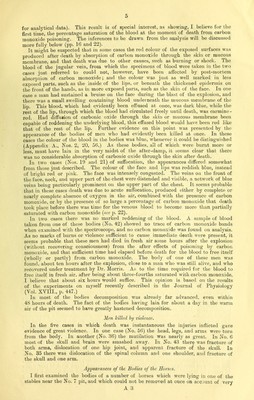
![Iii the case of many fiery pits, the foul air of the main return would become extinctive to lamps or candles before becoming explosive,* and when more than 6^ parts of black-damp were present to one of fire-clamp, the return air could never become explosive, although it might show a slight cap on a lamp. The next case is that of pure fire-damp explosions, in which an excess of fire-damp is present in some portions of the explosive air, i.e., more fire-damp than would suffice to consume the whole of the oxygen present. Such explosions are doubtless far more common than the first kind, because the distribution of fire-damp and oxygen in a pit is very irregular. This is partly due to the specific gravity of fire-damp being so low that it tends to accumulate in any high place, and partly to the fact that large spaces (goaves, stopped-off workings, &c), are often charged with mixtures, varying from air containing a little black-damp, or fire-damp, or both, to almost pure fire-damp or black-damp. In illustration of this latter statement I may quote the following analyses. No. 1, Sample of gas issuing violently from a boring into the main intake airway of Moss Pit, Harecastle, North Staffordshire. In consequence of a gobfire, followed at intervals by two small gas explosions, and by one large one, carried through the whole pit by dust, the bottom of the shafts had been filled up to stop all ventilation, and the pit left for some months to allow the heated air to cool. When a bore-hole was cautiously made into the main intake road, the accumulated gas issued at great pressure. A sample of this gas was collected and sent to me by Mr. W. N. Atkinson, Her Majesty's Inspector for North Staffordshire. (An account of the accident is given in his Annual Report for 1894) :—■ Fire-damp - - - - 91-Q1 Nitrogen ----- 5-93 Carbonic acid - - - 3*06 Carbonic oxide - - - - 0-Q0 100-00 This analysis illustrates well the result of completely stopping off a large area of workings in a fiery pit. The small percentage of nitrogen found was probably due to the small residue of black-damp left in the pit, and not yet completely displaced by the rapidly accumulating fire-damp. The carbonic acid seems mostly to have come off from the coal along with the fire-damp, as only about a third of the carbonic acid would be accounted for by the presence of the nitrogen, counting the latter as a constituent of black-damp. No. 2. Gras obtained from behind a stopping in the same pit, after the main roads had been reached, and the ventilation partly re-established. Air /Oxygen - 1-801 _ _ g.61 Air | Nitrogen - 7'81J Black-damp-fn^r0^en ■-, fa \ - 34*66 r ]_Carbonic acid - 3-19 J Fire-damp - 56*73 100-00 This gas would form inflammable mixtures with air almost as readily as would pure fire-damp. The black-damp had apparently been formed by air getting in behind the stoppings. The sample was very carefully examined to ascertain whether the fire-damp was absolutely pure methane. That this was the case follows almost certainly from the fact that in two successive determinations the contraction on explosion was exactly double the volume of carbonic acid formed. No. 3. Gas obtained through a pipe from behind a stopping in Podmore Hall Colliery, No. 4 pit. Behind the stopping were old workings. A constant slow stream of gas was issuing at all times from this stopping, into a return air-way, so evidently a little air was getting from the intake air-ways into the old workings, where its *It was shown, in the paper just referred to, that a mixture of black-damp and fire-damp, when added in increasing proportions to air, may first produce an atmosphere extinctive to open lights and lamps, and then an explosive atmosphere. The same is certainly true for mixtures of after-damp, fire-damp, and air, such as occur in a pit after an explosion.](https://iiif.wellcomecollection.org/image/b24398408_0012.jp2/full/800%2C/0/default.jpg)


 No text description is available for this image
 No text description is available for this image
 No text description is available for this image