Elements of therapeutics and practice according to the dosimetric system / by D'Oliveira Castro.
- Castro, D'Oliveira.
- Date:
- 1888
Licence: Public Domain Mark
Credit: Elements of therapeutics and practice according to the dosimetric system / by D'Oliveira Castro. Source: Wellcome Collection.
Provider: This material has been provided by the Francis A. Countway Library of Medicine, through the Medical Heritage Library. The original may be consulted at the Francis A. Countway Library of Medicine, Harvard Medical School.
158/526 (page 130)
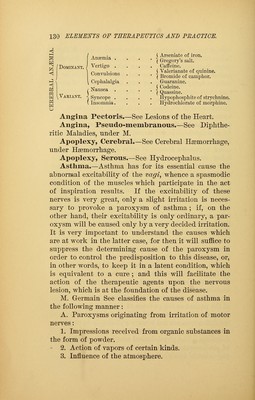
![Anagmia . Dominant. / Vertigo . Convulsions ( Nausea v Variant. ■] Syncope j Arseniate of iron. \ Gregory's salt. Caffeine. j Valerianate of quinine. ( Bromide of camphor. Guaranine. ( Codeine. ( Quassine. Hypophosphite of strychnine. Hydrochlorate of morphine. J ( \ Cephalalgia W . S ' Insomnia. w o Angina Pectoris.—See Lesions of the Heart. Angina, Pseudo-membranous.—See Diphthe- ritic Maladies, under M. Apoplexy, Cerebral.—See Cerebral Haemorrhage, under Haemorrhage. Apoplexy, Serous.—See Hydrocephalus. Asthma.—Asthma has for its essential cause the abnormal excitability of the vagi, whence a spasmodic condition of the muscles which participate in the act of inspiration results. If the excitability of these nerves is very great, only a slight irritation is neces- sary to provoke a paroxysm of asthma ; if, on the other hand, their excitability is only ordinary, a par- oxysm will be caused only by a very decided irritation. It is very important to understand the causes which are at work in the latter case, for then it will suffice to suppress the determining cause of the paroxysm in order to control the predisposition to this disease, or, in other words, to keep it in a latent condition, which is equivalent to a cure ; and this will facilitate the action of the therapeutic agents upon the nervous lesion, which is at the foundation of the disease. M. Germain See classifies the causes of asthma in the following manner : A. Paroxysms originating from irritation of motor nerves : 1. Impressions received from organic substances in the form of powder. 2. Action of vapors of certain kinds. 3. Influence of the atmosphere.](https://iiif.wellcomecollection.org/image/b21045471_0158.jp2/full/800%2C/0/default.jpg)