The London ambulance service. : Reports, etc., containing information collected by the General Purposes Committee of the Council with reference to ambulance provision existing in London, and in provincial and continental cities and towns, for dealing with cases of accident or sudden illness in the streets or other public places. / G.L. Gomme.
- London County Council
- Date:
- 1902
Licence: In copyright
Credit: The London ambulance service. : Reports, etc., containing information collected by the General Purposes Committee of the Council with reference to ambulance provision existing in London, and in provincial and continental cities and towns, for dealing with cases of accident or sudden illness in the streets or other public places. / G.L. Gomme. Source: Wellcome Collection.
Provider: This material has been provided by London School of Hygiene & Tropical Medicine Library & Archives Service. The original may be consulted at London School of Hygiene & Tropical Medicine Library & Archives Service.
23/38 page 21
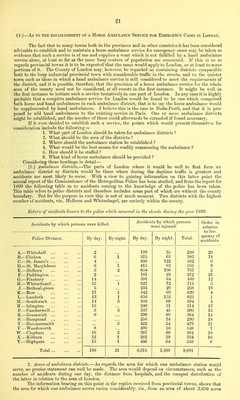
![(4.)—As TO THE ESTABLISHMENT OF A HoRSE AMBULANCE SERVICE FOR EMERGENCY CaSES IN LONDON. The fact that in many towns both in the provinces and in other countries it has been considered advisable to establish and to maintain a horse ambulance service for emergency cases may be taken as evidence that such a service is of use and supplies a want which is not fulfilled by a hand ambulance service alone, at least so far as the more busy centres of population are concerned. If this is so as regards provincial towns it is to be expected that the same would apply to London, or at least to some portions of it. The County of London may, however, be regarded as containing districts comparable both to the busy industrial provincial town with considerable traffic in the streets, and to the quieter town such as those in which a hand ambulance service is still considered to meet the requirements of the district, and it is possible, therefore, that the provision of a horse ambulance service for the whole area of the county need not be considered, at all events in the first instance. It might be well in the first instance to initiate such a service tentatively in one part of London. In any case it is highly probable that a complete ambulance service for London would be found to be one which comprised both horse and hand ambulances in each ambulance district, that is to say the horse ambulance would be supplemented by hand ambulances. I believe this is the case in Buda-Pesth, and that it is pro- posed to add hand ambulances to the existing service in Paris. One or more ambulance districts might be established, and the number of these could afterwards be extended if found necessaiy. If it were decided to establish such a service, the points which would present themselves for consideration include the following — 1. AVhat part of London should be taken for ambulance districts ? 2. What should be the area of the districts ? 3. Where should the ambulance station be established ? 4. What would be the best means for readily summoning the ambulance ? 5. How should it be staffed ? 6. What kind of horse ambulance shoi;ld be provided ? Considering these headings in detail— (1.) Ambulance districts,—The parts of London where it would be well to first form an ambulance district or districts would be those where during the daytime traffic is greatest and accidents are most likely to occur. With a view to gaining information on this latter point the annual report of the Commissioner of the Metropolitan ]-'olice has been studied, and from the report for 1899 the following table as to accidents coming to the knowledge of the police has been taken. This table refers to police districts and therefore includes areas part of which are without the county boundary. But for the purpose in view this is not of much moment. Two districts with the highest number of accidents, viz., Holborn and Whitechapel, are entirely within the county. Return of accidents Jinou-n to the police ichich occurred^ in the streets during the year 1899. Accidents by which persons were killed. Accidents by which persons were injured. Order in relation to fre- Police Division. By day. By night. By day. By night. Total. quency of accidents. A.—Whitehall 2 199 35 236 20 B.—Chelsea 6 i 315 61 383 14 C.—St. James's ... 4 436 122 562 6 D.—St. Marylebone 6 1 415 83 505 9 E.—Holborn ... 3 2 654 108 767 2 F.—Paddington ... 2 181 29 212 21 G.—Finsbury 14 391 64 469 12 H.—Whitechapel... 15 i 627 72 715 J.—Bethnal-green 5 234 29 268 19 K.—Bow 17 i 542 60 620 4 L.—Lambeth 13 1 656 153 825 1 M.—Southwark ... 14 3 509 68 594 5 N.—Islington 15 248 51 314 17 P.—Camberwell ... 5 3 337 45 390 13 R.—Gi-eenwich ... 6 298 60 364 15 S.—Hamptead ... 256 34 290 IS T.—Haramersmith 3 422 54 479 11 v.—Wandsworth s 490 50 548 7 W.—Claphani 16 3 387 88 494 10 X.—Kilburn 12 1 282 39 334 16 Y.—Highgate 15 1 436 64 516 8 Total 186 21 8,315 1,369 9,891 2. Areas of amb^dance districts.—As regards the area for which one ambulance station would serve, no precise statement can well be made. The area would depend on circumstances, such as the number of accidents during one daj^, the distance from hospitals, and the unequal distribution of the latter in relation to the area of London. The information bearing on this point in the replies received from provincial towns, shows that the area for which one ambulance serves varies considerably, viz., from an area of about 2,650 acres](https://iiif.wellcomecollection.org/image/b24398433_0023.jp2/full/800%2C/0/default.jpg)



 No text description is available for this image
 No text description is available for this image
 No text description is available for this image