On three several hurricanes of the Atlantic, and their relations to the northers of Mexico and Central America, with notices of other storms / by W.C. Redfield.
- William C. Redfield
- Date:
- 1846
Licence: Public Domain Mark
Credit: On three several hurricanes of the Atlantic, and their relations to the northers of Mexico and Central America, with notices of other storms / by W.C. Redfield. Source: Wellcome Collection.
Provider: This material has been provided by the National Library of Medicine (U.S.), through the Medical Heritage Library. The original may be consulted at the National Library of Medicine (U.S.)
24/142
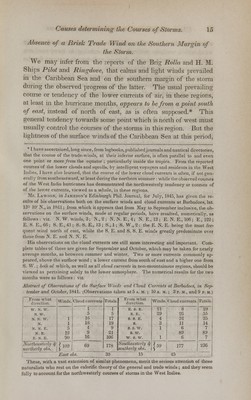
![southeastward,] and afterwards by N. to N. W. The gale lasted through the 2d of Octo- ber, and the schr. was driven near to the Campeche Bank.—(Statement of Capt. Collins.) 4. The brig Sabine, for Campeche, went ashore at the Alacranes, on the Campeche Bank, [lat. 22° 30', Ion. 89° 43',] Oct. 2d, in the hurricane, after cutting away both masts ; was left in two feet of water after the sea went down.—(Marine Report.) 5. The ship St. Mary left the bar of the Mississippi on the 29th of September ; on the 30th, wind E. N. E., squally, and a rolling sea from S. E.; lat. at noon 26° 33', Ion. 88° : prepared for bad weather. Oct. 1st, at noon lat. 25° 40', Ion. 88° 20'; calms and sudden gusts. Oct. 2d, before daylight the sea ran in all directions, as if at a distance the gale was blowing in a circle towards its center. At noon lat. 25° 20', Ion. 88° 40'; dense clouds in the eastern horizon and a cross sea. At 7 p. m. on the 2d, after a calm, a tremendous gust from the east struck the ship ; the hurricane had now commenced in earnest, and with a force seldom felt. The wind con- tinued without cessation ; and early in the morning of the 3d, the ship was hove to under a small storm staysail, which soon blew to fragments. Lat. at noon 24° 10', Ion. 89° ; the wind from the East continued to blow without intermission, with tremendous force; the sea ran cross and high, and the deck load was thrown overboard. Shortly after noon the wind veered suddenly to North, and blew with increased fury. The east sea, break- ing in upon the decks, swept away from the lashings every movable article, burst in the front of the cabin and filled it with water. About 4 p. m. the wind shifted suddenly to the westward and blew, if it was possible, with still greater fury—the ship now on her beam ends, and the sea making a clear breach over her. It being evident the ship was settling and must soon go to the bottom, the only resource was adopted of cutting away the masts, and the topmasts and foremast went over the side. At 6 p. m. the extreme fury of the tempest ceased, leaving a prodigious sea, and the ship lay during the night a helpless wreck.t The position at noon of the 4th, by good observations, was lat. 23° 57', Ion. 89° 30', near the Bank of Campeche.—(Journal of Capt. Foster.) 6. Barque Claremont, from Laguna, on the 3d and 4th of October, lat. 25°, Ion. 87°, had a severe gale of wind from S. E. to S. W.—(Marine Report.) [The veering of the wind in this case from the eastern to the southern and western quarter, the course of the storm being northeastward, shows this vessel to have been on the right of the line pursued by the axis of the gale. The opposite course and suddenness of the wind's changes with the St. Mary, show this ship to have been in the left center of the storm, and near the line pursued by its axis; the latter passing between the two vessels.] 7. Brig Jena was wrecked in the hurricane on the 4th of October, in lat. 25° 35', Ion. 87°. 8. Barque Helen Maria encountered the gale of the 4th-5th of October, off the Balize, and returned on the 12th. 9. Brig Kanhawa, from JNew Orleans, on the 4th and 5th of October, lat. 28°, Ion. 86° 45', experienced a violent hurricane from the east; was hove on her beam ends, lost spars, &c.—(Marine Reports.) It may be perceived that this storm advanced but slowly, par- ticularly on its first entrance upon the Gulf of Mexico. Capt. Bunker, of the ship Alabama, for New Orleans, was hence enabled to avail himself of the strong southeasterly winds pertaining to the right front of the storm, in making a rapid passage from near * Capt. Foster states that his D. R. longitudes were found too far east, on getting an observa- tion, owing to the strong westerly current then prevailing. 1 Capt. Foster states that the carcasses of sea and land birds, in great numbers, were floating in the sea the day after the hurricane. These last could not have come from land to the east- ward or even northward of the ship, as the winds then prevailed; but must have been blown from southern Mexico or Yucatan by a gale turning south and east around its axis.](https://iiif.wellcomecollection.org/image/b21149549_0024.jp2/full/800%2C/0/default.jpg)