[Report 1967] / Medical Officer of Health, Bedford Borough.
- Bedford Borough Council
- Date:
- 1967
Licence: Attribution 4.0 International (CC BY 4.0)
Credit: [Report 1967] / Medical Officer of Health, Bedford Borough. Source: Wellcome Collection.
49/124 page 47
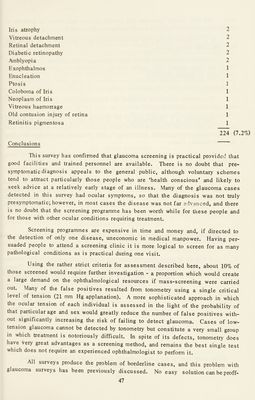
![Iris atrophy 2 Vitreous detachment 2 Retinal detachment 2 Diabetic retinopathy 2 Amblyopia 2 Exophthalmos 1 Enucleation 1 Ptosis ] Coloboma of Iris 1 Neoplasm of Iris 1 Vitreous haemorrage 1 Old contusion injury of retina 1 Retinitis pigmentosa 1 224 (7.2%) Conclusions This survey has confirmed that glaucoma screening is practical provided that good facilities and trained personnel are available. There is no doubt that pre- symptomaticdiagnosis appeals to the general public, although voluntary schemes tend to attract particularly those people who are ‘health conscious* and likely to seek advice at a relatively early stage of an illness. Many of the glaucoma cases detected in this survey had ocular symptoms, so that the diagnosis was not truly presymptomatic; however, in most cases the disease was not far advanced, and there is no doubt that the screening programme has been worth while for tiiese people and for those with other ocular conditions requiring treatment. Screening programmes are expensive in time and money and, if directed to the detection of only one disease, uneconomic in medical manpower. Having per- suaded people to attend a screening clinic it is more logical to screen for as many pathological conditions as is practical during one visit. Using the rather strict criteria for assessment described here, about 10% of those screened would require further investigation - a proportion which would create a large demand on the ophthalmological resources if mass-screening were carried out. Many of the false positives resulted from tonometry using a single critical level of tension (21 mm Hg applanation). ■ A more sophisticated approach in which the ocular tension of each individual is assessed in the light of the probability of that particular age and sex would greatly reduce the number of false positives with- out significantly increasing the risk of failing to detect glaucoma. Cases of low- tension glaucoma cannot be detected by tonometry but constitute a very small group in which treatment is notoriously difficult. In spite of its defects, tonometry does have very great advantages as a screening method, and remains the best single test which does not require an experienced ophthalmologist to perform it. All surveys produce the problem of borderline cases, and this problem with glaucoma surveys has been previously discussed. No easy solution can be proff-](https://iiif.wellcomecollection.org/image/b28912962_0049.jp2/full/800%2C/0/default.jpg)