On some of the pathological and physiological relations of brain, mind, and higher nerve function : being the address delivered at the beginning of the session of the Pathological and Clinical Society of Glasgow / by Alexander Robertson.
- Robertson, Alexander
- Date:
- [between 1800 and 1899]
Licence: Public Domain Mark
Credit: On some of the pathological and physiological relations of brain, mind, and higher nerve function : being the address delivered at the beginning of the session of the Pathological and Clinical Society of Glasgow / by Alexander Robertson. Source: Wellcome Collection.
Provider: This material has been provided by The University of Glasgow Library. The original may be consulted at The University of Glasgow Library.
58/67 (page 30)
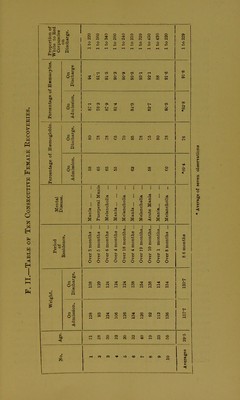
![which calls for comment under this head is that the improve- ment in the quality of the blood was more pronounced in the young, and in those advanced in years, than in the middle-aged. In the aggregate the 22 patients gained 179 lbs in 78 months, or an average of 8*1 lb. in 3*5 months j 18 gained an aggregate of 188 lbs., three lost an aggregate of 9 lbs., and one re- mained stationary. The average percentage of haemoglobin in the first observations on each individual, i.e,, before the treatment was commenced, was 61; in the last observations, or when the treatment was discontinued, 70. In 18 cases there was a definite increase varying from six to twenty per cent., in two a diminution—eight per cent, in one case, nine per cent, in the other ] while two cases did not vary. The average amount of haemacytes was 81*1 for the first observation, 89*2 for the last. The percentage was increased in twenty cases, the gain fiuctuat- ing between 1*9 the lowest and 26*3 the highest amount gained. In two cases there was loss, but in neither instance did this exceed two per cent. The proportion of white to red corpuscles showed considerable variations, but not in any definite direction. The average of the first observation was 1 to 384, of the last 1 to 320. Haematoblasts were seen in nearly all of the obser- vations, the exceptions being the first observation in three cases, and the last observation in the individual who died. Many of the red-blood corpuscles throughout the series were of smaller size than normal, and in addition were feebly coloured. In no case did the blood show any marked deterioration after the tonic treatment was discontinued. The cases which had no medical treatment, and those treated with cod-liver oil and a bitter tonic (quassia), differed fi-om the rest of the series in that there were considerable fluctuations in the quality of the blood at the different periods. In the instances where an increase in the amount of haemoglobin and haemacytes was recorded this did not take place uniformly, and the total increase did not amount to 10 per cent, in either case. On the other hand the blood of those in whom iron, either alone or in combination, formed part of the treatment, varied in a definite and particular way. For the first fortnight the haemoglobin remained stationary, while the amount of haema- cytes was largely increased. In the third and fourth weeks the haemoglobin continued stationary and the haemacytes were diminished. During the second month the haemoglobin was slightly increased in all the cases, while the percentage of haemacytes increased in the patients progressing towards mental recovery, but diminished in the others. In each instance improvement in the amount of haemacytes preceded](https://iiif.wellcomecollection.org/image/b24918921_0058.jp2/full/800%2C/0/default.jpg)