Life and trial of Dr. Abner Baker, Jr : (a monomaniac), who was executed October 3, 1845, for the alleged murder of his brother-in-law, Daniel Bates : including letters and petitions in favor of a pardon, and narrative of the circumstances attending his execution, etc. etc. / by C.W. Crozier ; trial and evidence by A.R. M'Kee.
- Crozier, C. W.
- Date:
- 1846
Licence: Public Domain Mark
Credit: Life and trial of Dr. Abner Baker, Jr : (a monomaniac), who was executed October 3, 1845, for the alleged murder of his brother-in-law, Daniel Bates : including letters and petitions in favor of a pardon, and narrative of the circumstances attending his execution, etc. etc. / by C.W. Crozier ; trial and evidence by A.R. M'Kee. Source: Wellcome Collection.
Provider: This material has been provided by the National Library of Medicine (U.S.), through the Medical Heritage Library. The original may be consulted at the National Library of Medicine (U.S.)
103/174
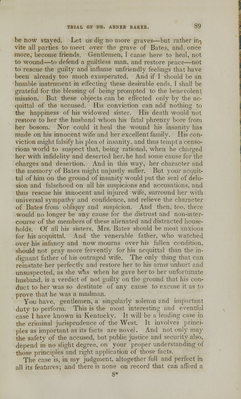
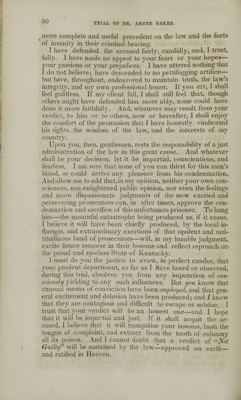
![oxisma] designs, to kill Bates. But, returning to settle his affairs, he was excited, by his delusions and by the apprehension that Bates meditated his destruction, to pass heedlessly within the range of his gun, and being, on the'first sight of him, transported with ungoverna- ble fury, he insanely dismounted, and fired at the side of Bates as he sat under a shelter where he could not rationally have expected o kill him, and where, whether he hit or missed, Bates must have it- stantly seen him and been able to have killed him belore he could have escaped. Who can doubt that, had he not labored under in- sane delusions and been impelled by ungovernable enlotions arising from them, he would not then have thus passed and dismounted, or then, if ever, have shot at Bates? And who can doubt, therefore, that, whatever cause of complaint or of apprehension of danger he may have had, the killing, as it occurred, was the offspring of insan- ity—the insane act of an insane-man? And, under all these circumstances, will the law assume—or can you presume—that the accused knew that he was doing wrong, and also had the moral power to avoid the act? Never, never, if the law be just and you be rational. Does it appear here (as in the moot case on which the 12 Judges of England expressed an opinion) that the accused knew that he was violating the law, was actuated by re- venge, and acted with a moral free will and full discretion? Revenge for what? For Bates' imputed conduct to his own wife, and designs on the life of the accused? Then why had he not attempted to kill him for this cause when he had multiplied opportunities of attempt- ing it without personal hazard? No, it was not the voluntary ven- geance of a sane mind, but the unavoidable act of a mind diseased, and dethroned, and impelled by an insane conviction that the act was one of lawful and righteous self-defence and retribution. Such, in my judgment, is the deduction of enlightened reason, and the pre- sumption of rational and well established law. But not only will the law presume that such an act, prompted by such insane delusion, was committed without a consciousness that, under all its imagined as well as actual circumstances, it was wrong, or without the moral power, at the time, to avoid it—but, in this case, there is affirmative proof of unconsciousness of wrong and also of moral inability. The accused neither attempted to escape, nor man- ifested any contrition or alarm. On the contrary, he seemed unusual- ly tranquil and self-satisfied—endeavored to go on foot to the house of his wife's father, whom he had so much outraged, but, missing the way, went to her uncle's; slept there all night peacefully, narrated all the facts and causes in a spirit of triumph and self-complacency, as- severated that he had done a necessary and glorious deed—and volun- tarily surrendered himself to examining Justices, who, upon full investi- gation, discharged him on the ground of insanity. Then, were itpos- sible for you to believe that an insane man, when actuated by insani- ty, might be conscious that he is, in that particular act, doing wrong, and might have the moral power to refrain—still you have, in this case, as strong evidence as could exist in any case to sat*sfy you that](https://iiif.wellcomecollection.org/image/b21112058_0103.jp2/full/800%2C/0/default.jpg)