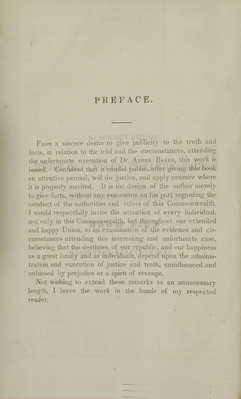
Life and trial of Dr. Abner Baker, Jr : (a monomaniac), who was executed October 3, 1845, for the alleged murder of his brother-in-law, Daniel Bates : including letters and petitions in favor of a pardon, and narrative of the circumstances attending his execution, etc. etc. / by C.W. Crozier ; trial and evidence by A.R. M'Kee.
- Crozier, C. W.
- Date:
- 1846
Licence: Public Domain Mark
Credit: Life and trial of Dr. Abner Baker, Jr : (a monomaniac), who was executed October 3, 1845, for the alleged murder of his brother-in-law, Daniel Bates : including letters and petitions in favor of a pardon, and narrative of the circumstances attending his execution, etc. etc. / by C.W. Crozier ; trial and evidence by A.R. M'Kee. Source: Wellcome Collection.
Provider: This material has been provided by the National Library of Medicine (U.S.), through the Medical Heritage Library. The original may be consulted at the National Library of Medicine (U.S.)
11/174
![est appearance of its existence. Frequently he accomplishes this so suc- cessfully, that he goes on for months unsuspected, except by very close observers, and then, under some casual excitement, losing command of himself, gives full and sudden vent to delusion in an act of mani- fest insanity. This often happens in monomania, and, as the act it- self may either be a mere explosion of folly, or harmless passion, or of unaccountable apprehension and hatred, or be a direct infraction of the laws of morality, such as the perpetration of murder without an external motive, it behooves us to be extremely on our guard against condemning as a crime, what is in truth a symptom of insanity; and not to add (he cruelty and ignominy of condemnation to the already severe visitation of disease. Frequently the crime is only the first palpable sign of existing insanity, and shews the necessity of scrupulous inquiry being institu- ted, when an unnatural act is committed by an individual who would previously have revolted at it. ''From the same power of long suppressing the appearance of ab- erration in conduct and in conversation, arises the acknowledged greater difficulty of curing monomania than mania itself. The symptoms are so long concealed that the disease takes deep root be- fore it is discovered, andevenwhen it is found out, from the barbarous ous stigma attached to the name of insanity, there is often great diffi- culty in subjecting the patient to the necessary medical and moral treatment. [From Beck's Medical Jurisprudence.] Monomania.—Here the permanent delirium is confined to one ob- ject, or to a small number of them The sufferers are pursued day and night by the same ideas and affections, and they give themselves up to these with profound ardour and devotion. They often appear reasonable, when conversing on subjects beyond the sphere of their delirium, until some external impression suddenly rouses the diseased train. The character of this form of insanity is very various, and depends on the predominant species of delusion that is present. This description of lunatics eat much, but sometimes they endure hunger with great obstinacy, they have frequent pains in the bowels, and costiveness is common. The pulse is full, hard and strong, and the skin warm. Probably this is a form of insanity as common as any other. The difficulty in detecting this disease is increased by the remark- able cunning and dissimulation of which some maniacs are capable.](https://iiif.wellcomecollection.org/image/b21112058_0011.jp2/full/800%2C/0/default.jpg)