Remarks on the topography and diseases of the Gold Coast / by R. Clarke.
- Clarke, R.
- Date:
- 1860
Licence: Public Domain Mark
Credit: Remarks on the topography and diseases of the Gold Coast / by R. Clarke. Source: Wellcome Collection.
Provider: This material has been provided by The University of Glasgow Library. The original may be consulted at The University of Glasgow Library.
2/60
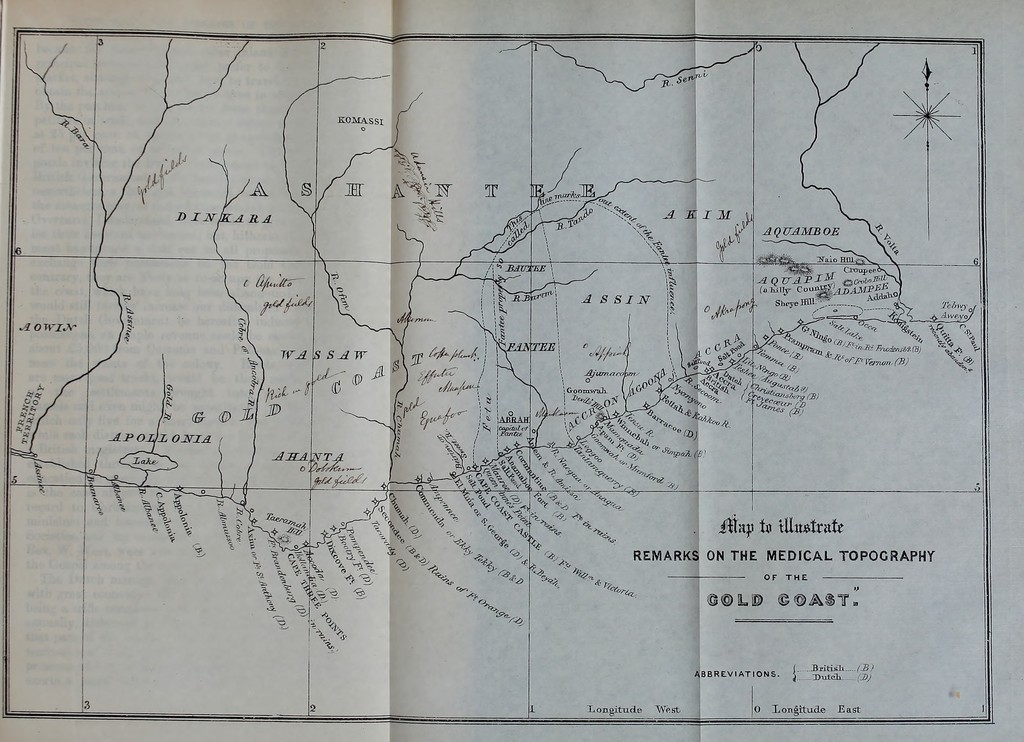
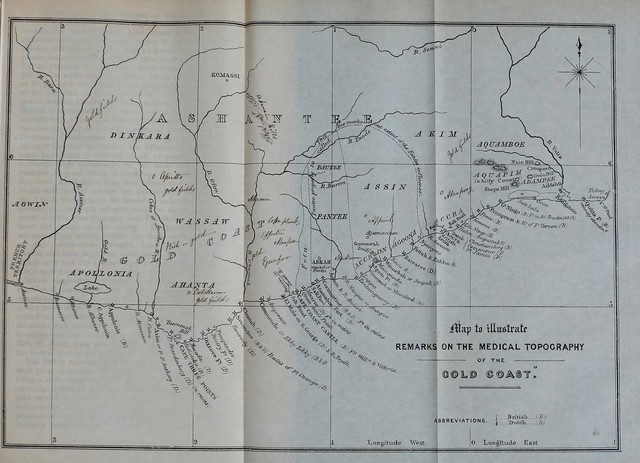
![Remarks on the topography and diseases of the gold coast, x By R. CLARKE, Esq., late of H.M. Colonial Medical Service; and formerly Acting Judicial Assessor of tbe Gold Coast. IRr.ad before the Epidemiological Society, Monday, Slay 7th, I860.] Before entering upon the immediate subject of this paper, I shall endeavour to give an outline of the general divisions of the Gold Coast, and the races inhabiting it. The Gold Coast is divided into the two great divisions of the Leeward or East- ern Districts, and the Windward or Western Districts; the Secoom, a small river, some eight miles from Accra, being the boundary line between them. The British forts and villages along the seaboard are situated at irregular distances, from Cape Appollonia on the west, to the river Volta on the east, an extent of about two hundred and forty miles, and lying between 4° 40' and 5° 40' of north latitude, and from the meridian to about 3° of west longitude. Addah, Quitta Port; (lately abandoned), Ningo, Pram Pram, Pony, Temma, Teshi, Labadee, Christianborgh Castle, and James Fort, British Accra, are within the former or Leeward division; while Appollonia, Dixcove Fort, British Secundee, and Commendah, Cape Coast Castle, Animaboo Fort, Coroman- tine, Mumford, Tantunquerry, and Winnebah, are included in the latter or Windward division. Besides these towns and larger villages, there are numerous hamlets along this line of sea coast, which it is here unnecessary to note. But, from the fact of the forts and stations belonging to the British and Dutch governments closely intersecting each other at short distances between Appollonia and Accra, great and almost insurmountable difficulties are constantly arising be- tween the two governments. At Accra their proximity is strikingly illustrated, British Accra being only separated from Dutch Accra by an imaginary line ; the people of these towns being, moreover, bound together by the ties of blood, language, laws, and customs. As an example of the dif- ficulties just alluded to, I may here instance the fact that the imposition of a fixed duty of two per cent, upon the in- voice price of all imports into British waters on the Gold Coast has been a source of discontent to the British mercan- tile community, because they have to compete with the mer- chants of the neighbouring Dutch towns, who pay no duty, and](https://iiif.wellcomecollection.org/image/b21457323_0004.jp2/full/800%2C/0/default.jpg)