Vegetable substances used for the food of man / [Edwin Lankester. Revised and partly rewritten].
- Edwin Lankester
- Date:
- 1846
Licence: Public Domain Mark
Credit: Vegetable substances used for the food of man / [Edwin Lankester. Revised and partly rewritten]. Source: Wellcome Collection.
72/518 page 66
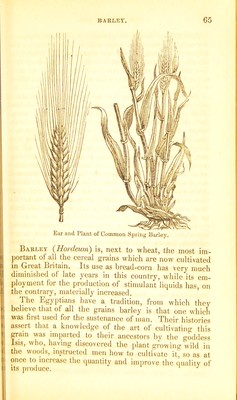
![Uninstructed people are generally prone to refer to supernatural agency, the origin of all events for which they are otherwise unable to account. Dr. Franklin has related, as coming from the lips of a chief of the Susquehannah Indians, a tradition very similar to that of the Egyptians. “ In the beginning,” said this child of nature, “ our fathers had only the flesh of animals to subsist on ; and if their hunting was unsuccessful they were starving. 'I'wo of our young hunters having killed a deer, made a fire in the woods to broil some part of it. When they were about to satisfy their hunger, they beheld a beautiful young woman descend from the clouds, and seat herself on that hill which you see 3'onder among the blue mountains. They said to each other. It is a spirit that i)erhaps has smelt our broiling venison, and wishes to eat of it; let us offer some to her. They presented her with the tongue; she was pleased with the taste of it, and said. Your kindness shall be rewarded. Come to this place after thirteen moons, and you shall find something that will be of great benefit in nourishing you and your children to the latest generations. They did so, and to their great surprise found plants they had never seen before, but which from that ancient time have been constantly’ cultivated among us to our great advantage. M here her right-hand had touched the ground, they’ found maize ; where her left-hand had touched it, they’ found kidney-beans; and where she had seated herself they’ found tobacco.” The native country of barley’ is as little known as that of wheat. Some travellers have mentioned it as being ])roduced in a wild state in distant jmrts of the world ; but there is reason for believing that all state- ments to this effect have been foundcil in error, since the hardiest varieties of the cultivated grain have never yet been seen to ))ropagate themselves during two fol- lowing years. The seed of cultivated barley, when chance-sown, will indeed produce plants; but the grains w hich these bear are rarely, if ever, seen to ger- minate. Some grasses which have been placed by’](https://iiif.wellcomecollection.org/image/b22029710_0072.jp2/full/800%2C/0/default.jpg)



 No text description is available for this image
 No text description is available for this image
 No text description is available for this image