Vegetable substances used for the food of man / [Edwin Lankester. Revised and partly rewritten].
- Edwin Lankester
- Date:
- 1846
Licence: Public Domain Mark
Credit: Vegetable substances used for the food of man / [Edwin Lankester. Revised and partly rewritten]. Source: Wellcome Collection.
73/518 page 67
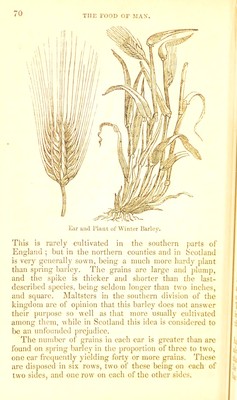
![botanists in the same genus with barley, bear to it a strong outward resemblance, yet none of them can, by any degree of culture, be brought into use as human food, nor indeed be made to exhibit any marked im- ])rovement. One of these grasses, the Hordeum murinmn of LiniiDeus, known commonly as wall-barley, bears the nearest resemblance of any to the cultivated plant. In one respect barley is of more importance to mankind than wheat. It may be ]jro])agated over a w'ider range of climate, bearing heat and drought better, growing upon lighter soils, and corning so quickly to maturity, that the short northern summers which do not admit of the ripening of wheat, are yet of long enough duration for the perfection of barley. It is the latest sown, and the earliest reaped of all the summer grains. In warm countries, such as Spain, the farmers can gather two harvests of barley within the year, one in the spring from winter-sown grain, and the other in autumn from that sown in summer. Barley sown in June is commonly ready for the sickle in three months from the time of the seed being committed to the ground ; and in very northern climates the period necessary for its growth and perfection is said to be of still shorter dura- tion. Linnseus relates, in his tour in Lulean Lapland, that on the 28th of July he observed the commence- ment of the barley harvest, and although the seed was sown only a few days before Midsummer, that the grain was perfectly ripe, the whole process having thus oc- cupied certainly not longer than six weeks. The property of not requiring moisture admirably fits barley for propagation in those noi-thern countries vvherc the duration of summer is limited to a very few months in the year, and where wet is of very rare occurrence from the time when the spring rains are over at the end of May or the beginning of June—after which period the seed-time commences—until the autumnal equinox, previous to which the harvest is reajicd. So hurtful is excessive moisture to the plants, that even heavy dews, if of frequent occurrence, arc found I injurious. Wet is detrimental at all periods; but the](https://iiif.wellcomecollection.org/image/b22029710_0073.jp2/full/800%2C/0/default.jpg)




 No text description is available for this image
 No text description is available for this image
 No text description is available for this image