Volume 1
The viviparous quadrupeds of North America / By John James Audubon ... and ... John Bachman.
- John James Audubon
- Date:
- 1846-1854
Licence: Public Domain Mark
Credit: The viviparous quadrupeds of North America / By John James Audubon ... and ... John Bachman. Source: Wellcome Collection.
98/420 page 76
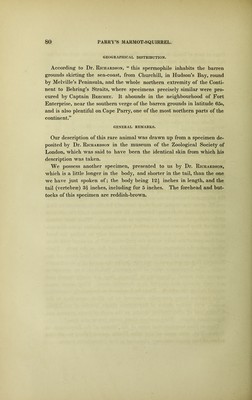
![GENUS SPERMOPHILUS. F CimER. DENTAL FORMULA. Incisive |; Canine ; Molar —] = 22. The dentition of the Spermophiles differs from that of the true mar- mots, in the following particulars. The first longitudinal eminence (col- line) is nearly obliterated, and the curve (talon) which unites the second to the third, is prolonged much more internally, which makes the molars of the Spermophiles more narrow transversely than longitudinally, as compared with those of the marmots. The teeth of the souslik (Spermo- philus citillus) were examined by F. Cuvier, and considered as typical of this genus. Nose, convex ; ears, generally short; cheek-pouches. Body, rather short; mammae, pectoral and abdominal, from eight to twelve. Feet, of moderate length, adapted for walking on the ground ; nails, less in size than those of the marmots, less hooked than those of the squirrels ; on the fore-feet, four toes, with the rudiment of a thumb, pro- tected by a blunt nail; second toe from the thumb longest, as in the marmots, and not the third, as in the squirrels ; hind-feet, with five toes. Tail, generally rather short, and always shorter than the body; in several of the species, capable of a slightly distichous arrangement. The species belonging to this genus differ from the true marmots, not only in their teeth, as shown above, but also in several other striking particulars. They have cheek-pouches, of which the marmots are desti- tute. They are by no means clumsy, and in form are rather slender, and possess a degree of lightness and agility, approaching the activity of the squirrels. With the genus Tamias, they assimilate so closely, that some of the species present intermediate characters, and authors may well differ as to which genus they ought to be referred to. Thus Tamias quadi'ivitta- tas, and Spermophilus lateralis, seem to form a connecting link between these two genera. It is to be recollected, however, that analogous cases exist, not only among the mammalia, but in every class of animals, and more especially in birds.](https://iiif.wellcomecollection.org/image/b22014421_0001_0098.jp2/full/800%2C/0/default.jpg)