[Report 1912] / School Medical Officer of Health, Salop / Shropshire County Council.
- Shropshire (England). County Council.
- Date:
- 1912
Licence: Attribution 4.0 International (CC BY 4.0)
Credit: [Report 1912] / School Medical Officer of Health, Salop / Shropshire County Council. Source: Wellcome Collection.
29/70 (page 27)
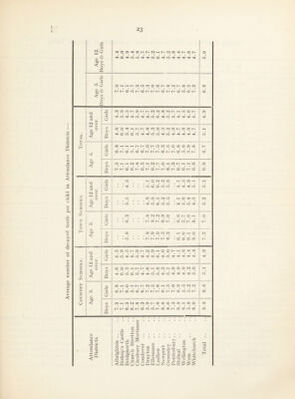
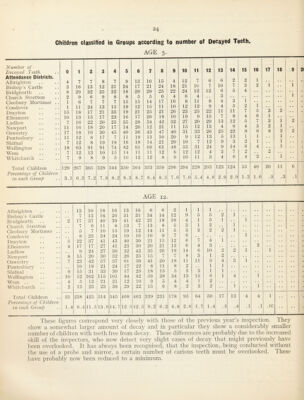
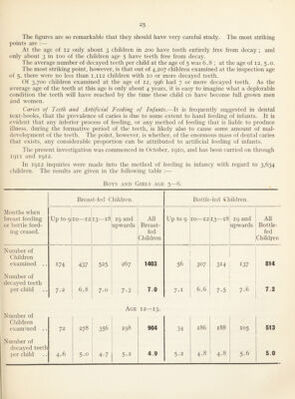
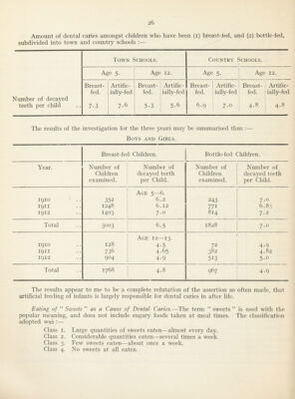
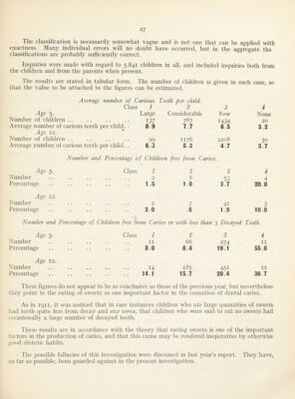
![The classification is necessarily somewhat vague and is not one that can be applied with exactness. Many individual errors will no doubt have occurred, but in the aggregate the classifications are probably sufficiently correct. Inquiries were made with regard to 5,841 children in all, and included inquiries both from the children and from the parents when present. The results are stated in tabular form. The number of children is given in each case, so that the value to be attached to the figures can be estimated. Average number of Carious Teeth per child. Class i 2 3 4 Age 5- Large Considerable Few None Number of children . . 137 787 1434 20 Average number of carious teeth per child.. 8.9 7.7 6.5 3.2 Age 12. Number of children . . 99 1176 2208 30 Average number of carious teeth per child. . 6.3 5.3 4.7 3.7 Number and Percentage 0 f Children free from Caries • Age 5. Class 1 2 3 4 Number 2 8 53 4 Percentage 1.5 1.0 3.7 20.0 Age 12. Number 2 7 41 3 Percentage 2.0 .6 1.9 10.0 Number and Percentage of Children free from Caries or with less than i ] Decayed Teeth. Age 5. Class 1 2 3 4 Number II 66 274 II Percentage 8.0 8.4 19.1 55.0 Age 12. Number 14 185 451 II Percentage 14.1 15.7 20.4 36.7 These figures do not appear to be so conclusive as those of the previous year, but nevertheless they point to the eating of sweets as one important factor in the causation of dental caries. As in 1911, it was noticed that in rare instances children who ate large quantities of sweets had teeth quite free from decay and vice versa, that children who were said to eat no sweets had occasionally a large number of decayed teeth. These results are in accordance with the theory that eating sweets is one of the important factors in the production of caries, and that this cause may be rendered inoperative by otherwise good dietetic habits. The possible fallacies of this investigation were discussed in last year’s report. They have, as far as possible, been guarded against in the present investigation.](https://iiif.wellcomecollection.org/image/b30087119_0029.jp2/full/800%2C/0/default.jpg)