Introductory address delivered at the opening of the course on physiology, for the session of 1861-2 : in the medical department of the University of the Pacific, at San Francisco, California, November 4th, 1861 / by Dr. L. C. Lane.
- Levi Cooper Lane
- Date:
- 1861
Licence: Public Domain Mark
Credit: Introductory address delivered at the opening of the course on physiology, for the session of 1861-2 : in the medical department of the University of the Pacific, at San Francisco, California, November 4th, 1861 / by Dr. L. C. Lane. Source: Wellcome Collection.
Provider: This material has been provided by the National Library of Medicine (U.S.), through the Medical Heritage Library. The original may be consulted at the National Library of Medicine (U.S.)
13/14
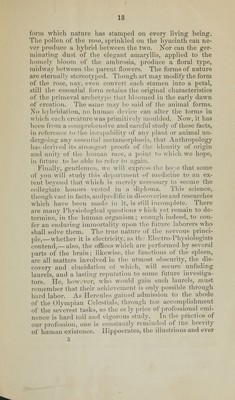
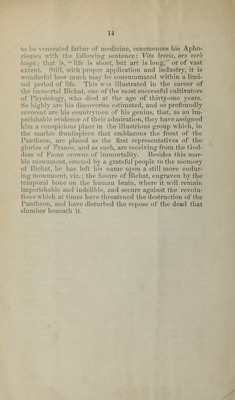
![form which nature has stamped on every living being. The pollen of tbe rose, sprinkled on the hyacinth can ne- ver produce a hybrid between the two. Nor can the ger- minating dust of the elegant amaryllis, applied to the homely bloom of the ambrosia, produce a floral type, midway between the parent flowers. The forms of nature are eternal Iy stereotyped. Though art may modify the form of the rose, nay, even convert each stamen into a petal, still the essential form retains the original characteristics of the primeval archetype that bloomed in the early dawn of creation. The same may be said of the animal forms. No hybridation, no human device can alter the forms in which each creature was primitively moulded. Now, it has been from a comprehensive and careful study of these facts, in reference to the incapability of any plant or animal un- dergoing any essentia! metamorphosis, that Anthropology has derived its strongest proofs of the identity of origin and unity of the human race, a point to which we hope, in future to be able to refer to again. Finally, gentlemen, we will express the hope that some of you will study this department of medicine to an ex- tent beyond that which is merely necessary to secuie the collegiate honors vested in a diploma. This science, though vast in facts, andprolific in discoveriseand researches which have been made in it, is still incomplete. There are many Physiological questions v hich yet remain to de- termine, in the human organism; enough indeed, to con- fer an enduring immortality upon the future laborers who shall solve them. The true nature of the nervous princi- p]e5—whether it is electricity, as the Electro-Physiologists contend,— also, the offices which are performed by several parts of the brain; likewise, the functions of the spleen, are all matters involved in the utmost obscurity, the dis- covery and elucidation of which, will secure unfading laurels, and a lasting reputation to some future investiga- tors. He, however, who would gain such laurels, must remember that their achievement is only possible through hard labor. As Hercules gained admission to the abode of the Olympian Celestials, through the accomplishment of the severest tasks, so the 01 ly price of professional emi- nence is hard toil and vigorous study. In the practice of our profession, one is constantly reminded of tlie brevity of human existence. Hippocrates, the illustrious and ever 3](https://iiif.wellcomecollection.org/image/b21135563_0013.jp2/full/800%2C/0/default.jpg)