Report on the outbreak of plague at Sydney [1900-1907] / by J. Ashburton Thompson, Chief Medical Officer of the Government and President of the Board of Health.
- New South Wales. Department of Public Health
- Date:
- 1900-1908
Licence: In copyright
Credit: Report on the outbreak of plague at Sydney [1900-1907] / by J. Ashburton Thompson, Chief Medical Officer of the Government and President of the Board of Health. Source: Wellcome Collection.
Provider: This material has been provided by London School of Hygiene & Tropical Medicine Library & Archives Service. The original may be consulted at London School of Hygiene & Tropical Medicine Library & Archives Service.
123/452 page 5
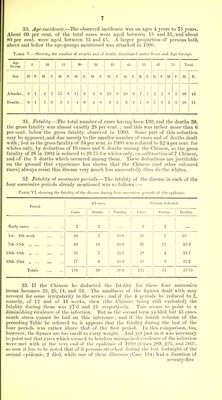
![18. The first case occurred daring the week ending 9th November, 1931. Eor thirty-four days it stood alona ; a second then happened during the week ending 14th December. After another interval of thirty-five days a third person was attacked during the week ending 11th January, 1902, and with this the epidemic began. The first two cases being excepted, during the first six weeks (ending 15th February) 20 persons were attacked ; during tlie second six weeks, G9 persons ; during the third, 31; while during the latter five weeks, only 17 were attacked. These figures, which result from division of the series shown in '^J able If, column of attacks, in accordance with the marked increase in the weekly number of attacks during the seventh to the twelfth weeks, distinguish periods of increase, state, and decline of the epidemic. The onset of the epidemic was marked by extreme deliberateness at first, and by an almost regular acceleration in its later stages; Avhile its end during the weekending 14th June Avas abrupt and decisive. No doubtful cases were met with thereafter. ; 19. By lohoui notified.—Of (he above cases, 22 were notified from public hospitals, 92 by fifty-five medical practitioners, a:ul the reiuainiug 25 by stalf medical officers, ])y coroners, by the police, by friends, and ])y themselves, in about equal numbers. 20. Cases reported for Diagnosis.—Between 12th November, 1901, when the first case was notified, and 31st July, 1903, 112 cases of illness, which turned out not to be plague, were reported for diagnosis. Only one of them afforded good clinical ground for doul)t, but the morphological, cultural, and inoculation tests which were; applied to liquid abstracted from a SAvollen inguinal gland failed to reveal any micro-organism or any infective disease. One other gave clinical ground for doubt in a lesser degree, and was shown to be a cas3 of streptococcic infection connected with a chronic ulcer of the leg. 21. Ambulant Cases.—These did not exceed seven or eight in number altogether. But they could not be exactly discriminated, bccanse they were exhibited both in j^ersons Avho had personally applied for treatment immediately after attack and who subsequently passed through a well-marked illness, and in persons who had passed through a mild acnte stage Avitliout medical aid, and who applied for help daring convalescence, either for persistent weakness or for indurated and painful glands. This, Avitli addition of two or three cases A^ hicli ultimately came to light in consequence of late sappuration of glands, is what was observed during the epidemic of 1900 ; and, as on that occasion, the circumstances under Avhicli these cases came to notice render it likely enough that a few others may have occurred in which either advice never appeared to be necessary, or else was sought at so late a date that the true cause of illness was not discovered. Neither in 1900 nor during the epidemic under notice did we note anything which would give colour to a suggestion that cases of pestis minor occurred, or cases of benign glandular enlargement probably taking their origin from a very mild and success- fully resisted infection with plague. We have no practical knowledge of either of these described conditions. 22. Clinical Forms.—Of the 139 cases, 133 were of the bubonic form, G were of the septicasmic form. These proportions were practically the same as were observed in 1900, and, as on that occasion, no case of primary plague-pneumonia was met with. The general course of the disease was the same as has been already described (see lleport, 1930, pp. 3-7), but the following three clinical notes are worthy of record. 23. Mode of Onset.—This was often sudden. Thus the exact hour of attack was named by 22 patients; that is to say, they alleged that having been in good health they had fallen ill at 5 o'clock in the morning, or at half-past three in the afternoon, &c. In 71 cases, though the hour of attack could not be exactly fixed, yet it was ascertained to have been daring the first G hours after midnight in 9 of them, during the second G hours in 18, during the third G hours in 22, and during the fourth in 22. Sj in 19 other cases in which nothing exact was noted on this point, in 8 the attack Avas said to have been '•'sudden, and in 11 others to have occurred while at v.^ork. In If cases the onset was definitely ascertained to have been gradual. 24.](https://iiif.wellcomecollection.org/image/b21354704_0123.jp2/full/800%2C/0/default.jpg)