Report on the outbreak of plague at Sydney [1900-1907] / by J. Ashburton Thompson, Chief Medical Officer of the Government and President of the Board of Health.
- New South Wales. Department of Public Health
- Date:
- 1900-1908
Licence: In copyright
Credit: Report on the outbreak of plague at Sydney [1900-1907] / by J. Ashburton Thompson, Chief Medical Officer of the Government and President of the Board of Health. Source: Wellcome Collection.
Provider: This material has been provided by London School of Hygiene & Tropical Medicine Library & Archives Service. The original may be consulted at London School of Hygiene & Tropical Medicine Library & Archives Service.
128/452 page 10
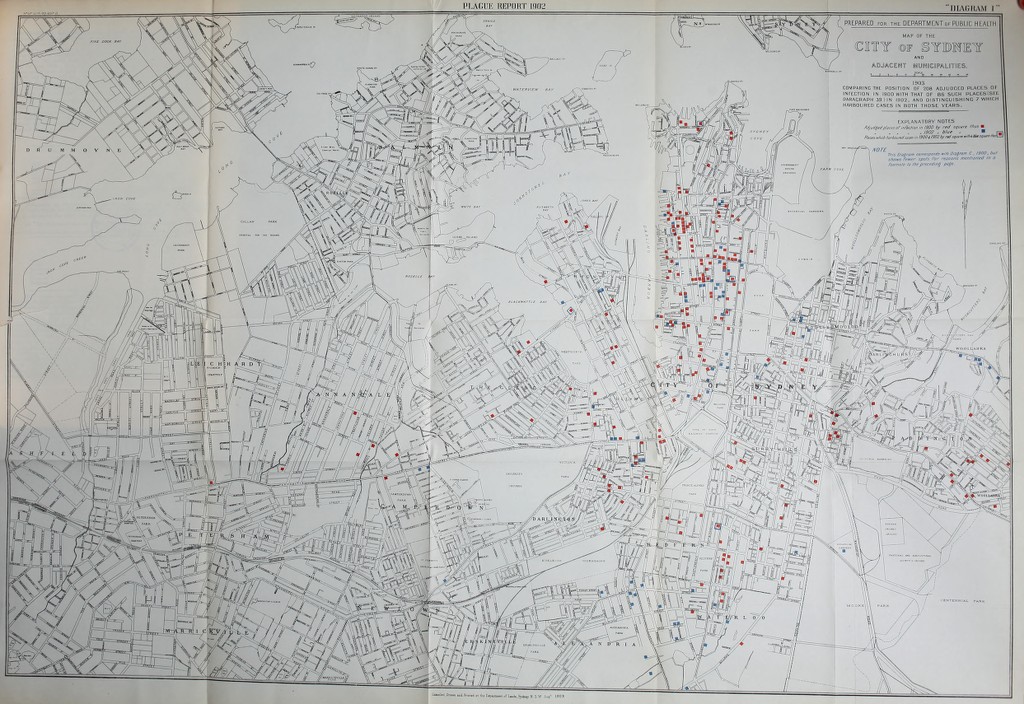
![of 6 premises which were adjudged places of infection in 1900, 4 were also adjudged places of infection in 1902. But the total adjudged places of infection in 1902 was 86 ; it follows that 80 of them were infected for the first time in 1902, while, on the other hand, 221 less 6 or 215 houses adjudged to have been places of infection in 1900 were spared in 1902 : whence it is plain that the infection of 1900 showed no tendency to persist on individual premises. It will he noticed, also, that the 4i premises on which cases were adjudged to have been infected both in 1900 and in 1902, were used in ways known to be likely to attract rats to them. 4]. It maybe objected that so far cognisance has been taken only of premises in relation to cases in man, and that all of them were disinfected so effectually that the virus had no opportunity of establishing itself upon them. But the statement is that place-infection can also originate with introduction of infected rats to premises ; now, although all those premises on which plague-rats were found were disinfected as carefully as though cases, too, had occurred upon them, yet it cannot be pretended that plague-rats were detected on all the premises which they had visited, or even Avhere they had died. It might be supposed, therefore, that the 80 places of adjudged infection, apparently first made infective in 1902, may really represent that residuum of the many places which had been infected by plague-rats in 1900, which had then escaped disinfection, in which the virus had (a) succeeded in persisting, and in Avbicli (b) circumstances had secured its communication to man in 1902, To this, of course, no direct reply could be made. But after perusing the description of the mode of spread below, the reader will be in a posiiion to judge how far the ascertained cause of the infectiveness of these houses in 1902 discounts the speculative supposition mentioned. lidi. I conclude that there is no evidence of the occurrence at Sydney of place- infection in the Indian sense, and that the infectivity of premises in 1902 was due to the presence on them of the plague-rats of 1902. Cases in which the place oe Infection remained undeteemined. 4s'}. Prom the total 139 cases, one, attacked on board the ship Eulomene, may be excepted ; it is fully described below. Of the remaining 138 the place of infection Avas deiermined in 113; and that number of cases were adjudged to have received the infection on 86 different premises. Remain, therefore, 25 cases in which the available information did not suffice to indicate any particular place as probably having been that at which the infection was taken. Two of the 25 were Chinese; 4 of them were idlers or prostitutes; 3 were labourers out of work, who were taken ill while searching for employment; 3 others were boys under 15; and .3 were either rat-catchers or scavengers in employment of the local authority for the City of Sydney, whose occupation led them into special danger at many different places. There remain 10 cases, therefore, in which it might be reasonably expected that the place of their infection would be discoverable. The history of each of them prior to attack was very carefully inquired into, and although nothing of apparent importance was elicited, the following data concerning some of them are worth mention. One was a druggist; one was a groom, who slept over a stable and in the same building witli his horses'-feed; anotiier was a clergyman actively occupied in district-visitiixg ; anotiier habitually gathered mill-wastes for poultry-feed at places on the Darling Harbour area (see page 31); another was an unemployed man, apparently not an idler, but whose movements were obscure. Other 3 w^ere house- wives, one was a waitress at a restaurant, and one a barmaid (see par. 41). Evidently many of these persons ran, or were likely to run, into danger in the course of their occupation or idle wanderings, at a time Avhen plague was epizootic and epidemic. Origin of the Epidemic. 46. The only hypotheses worth serious examination, in our opinion, are the two following : Either the epidemic depended on a recrudescence of the epizootic of 1900, or upon a second epizootic «et going by newly imported plague-rats. As to the former, we had reason to believe that the epizootic of 1900 died out in the course of that year, but the evidence gathered was insufficient to establish the fact; still, the recurrence was apparently too long delayed to have been a recrudescence, the interval](https://iiif.wellcomecollection.org/image/b21354704_0128.jp2/full/800%2C/0/default.jpg)