Report on the outbreak of plague at Sydney [1900-1907] / by J. Ashburton Thompson, Chief Medical Officer of the Government and President of the Board of Health.
- New South Wales. Department of Public Health
- Date:
- 1900-1908
Licence: In copyright
Credit: Report on the outbreak of plague at Sydney [1900-1907] / by J. Ashburton Thompson, Chief Medical Officer of the Government and President of the Board of Health. Source: Wellcome Collection.
Provider: This material has been provided by London School of Hygiene & Tropical Medicine Library & Archives Service. The original may be consulted at London School of Hygiene & Tropical Medicine Library & Archives Service.
245/452
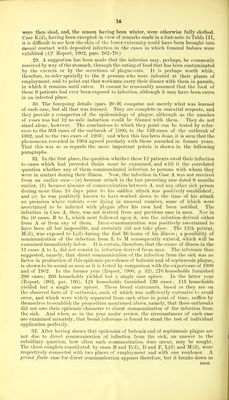
![1^ Of the seven septicpemic cases six died and one (D) recovered. The specimen of blood from Case D, which yielded positive results on culture only (the bacilli not being detected in the smears), was taken on April 25th, 1904. A second specimen, taken two days later (April 27th), gave negative results with both smears and cultures. In the interval between the two examinations the patient ha.d received 340 ccm. of serum (Yersin). Of the fatal cases, one (H) was not definitely proved to be septic£emic [vide supra), and another (L) died prior to coming under observation. The other four were shown to be septic;emic dui'ing life. Two of them (I and M) died on the same da}' that the specimen yielding plague bacilli was taken from them ; one (K) died on the next day, and one (E) on the fourth day after the septica'uiic blood was taken. The five non-septiciemic cases all recovered. F. T. 26. In the nine cases wliicli exhibited primary buboes search for points of entry of the infection resulted as shown in the table below Tabi.k nr.- 1901. Case. Situation of Bubo. Lesion of Drainage Area, A Femoral... Traces of tlea-bites ; no local reaction. B Recent finger-nail scratches. C Traces of tiea-bites : no local reaction. D W) Inflammation and pustulation of hair follicles (dirt). F None. G m Subpectoral K(d) ... ... ,, (but see note). NoTK.—On reference to the account of Case K(d) above, it will be seen that the j.)atient had cut his thumb with a jien-knife 7 days before attack ; that the wound had bled on the 6th and •5th days before it; that he had dried the blood with blotting-paper at his office ; that rat's dung was found in the drawer of the office-table he used ; and that plague-rats were identified on the premises during search after notification of his case. If he received the infection through the wound (but I know of no experimental evidence touching possibility of infecting animals with plague by inoculation of the dung of plague-infected rats), apparently his bubo should have occurred in the axillary glands ; in fact it appeared in a subpectoral gland, while the axillary glands were not tangibly enlarged. This case should be compared with tliat related to the Plague Commission in India by Captain H. W. Elphick, I.M.H. (Q. 9568), in which a hospital assistant who had wounded the back of his hand with a rib of a plague-corpse fell ill with plague within 48 hours afterwards, and exhibited no axillary, but a subpectoral bubo. Captain Elphick accepted the case as showing that the bubo is not necessarily situated in the group of glands directly related to the seat of inoculation. It is worth noting that when his patient was first examined (namely about 48 hours after receipt of the injury) the scratches had quite healed, and showed no signs of local reaction. Absence of local reaction and of lymphangitis were noted in the case of K(d), and in the following also which occurred during the current year at Newcastle. T>v. L. wounded his left hand twice in making a 2)ost mortem examination of the body of a man wlio had died of plague ; pure carbolic acid was at once applied to these injuries. Almost exactly 24 hours later he began to fe(>l ill, and at the same time felt discomfort in his right axilla, where a bubo subsequently developed. This ih-ew attention to his right hand on which a very small breach of the e[)ithelium was discovered at the base of one of the nails. The diagnosis of plague was bacteriologically confirmed in the usual way. The wounds of the left hand seemed to give no trouble. 27. In the case of E(d) alone, then, were there yisil)le lesions of the drainage area (as well as of other jmrts of the body-surface) which might have furnished points of entrance for deposited infection casually encountered; for the finger-nail scratches in Case B had an appearance of recency Avhen they were tirst examined at the 72nd hour of illness—much longer, therefore, after the hour of infection—so that it is almost certain they were made after the infection had been received, and were not the point of entrance. So also the traces of flea-bites in Cases A, C, and D, were first observed at the 29th, 58th, and 72nd liour of illness (much longer- after reception of the infection), and for that reason could not be conclusively regarded as points of entry. Lastly, in the 4 cases E, (J, K(d), and 1(d), no lesion could be found. In point of fact, any lesion of the skin which was minute, though sufficient to give entrance to the virus, had had ample time to heal before thest; patients fell under observation ; and, in general, it is not to be expected that such a lesion should be identilial)le, unless the virus had caused inflammatory changes in its neighbourhood, or unless its infliction had been attended by sharp |)ain, or by some other circumstance which attracted attention at the time. 28. As regards inoculation of the virus into the (damaged or ])roken) skin of drainage-areas by casual contact with inanimate bodies infected by Avandering plague- rats, it is to be observed that while the dwelling was the place of infection in cases 1(d), L(d), and M(d), who, therefore, were certainly exposed to that risk, the infection was received at places of emj)loyiuent in the remaining 9 cases., Tliese 9 patients were](https://iiif.wellcomecollection.org/image/b21354704_0245.jp2/full/800%2C/0/default.jpg)