Report on the outbreak of plague at Sydney [1900-1907] / by J. Ashburton Thompson, Chief Medical Officer of the Government and President of the Board of Health.
- New South Wales. Department of Public Health
- Date:
- 1900-1908
Licence: In copyright
Credit: Report on the outbreak of plague at Sydney [1900-1907] / by J. Ashburton Thompson, Chief Medical Officer of the Government and President of the Board of Health. Source: Wellcome Collection.
Provider: This material has been provided by London School of Hygiene & Tropical Medicine Library & Archives Service. The original may be consulted at London School of Hygiene & Tropical Medicine Library & Archives Service.
81/452 page 75
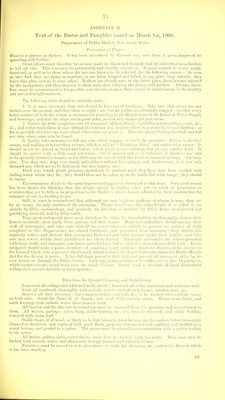
![APPENDIX H. Text of the Poster cand Pamphlet issued on March 1st, 1900. Department of Pul^lic Health, New South Wales. Prevention of Phigue. Plague is present in Sydney. It lias been introduced by diseased rats, and there is great danger of its spreading still further. Great efforts must therefore be at once made by Municipal Councils and by individual householders to kill all rats. This war must be persistently and steadily carried on. It must extend to every neigh- bourhood, as well as to those where the rats arc known to be infected, for the following reason :—As soon as rats find they arc dying in numbers, or are being trapped and killed, in any place they inhabit, they leave that place and go to some other. If there are already rats at the latter place, these become infected by the immigrants, and then disperse in their turn, thus carrying the disease still further. All rats, there- fore, must be exterminated as far possible, and the attack upon them should be simultaneous in the healthy and infected neighbourhoods. The follov\'ing hints should be carefully read :— 1. It is most necessary that I'ats should be kept out of dwellings. Take care that doors are not broken near the ground, and close them at night; see that all gullies are effectually trapped ; see that every house connected with the sewers is so connected according to the Regulations of the Board of Water Supply and Sewerage, and that the traps are in good order, so that rats cannot get past them. 2. Gather up with scrupulous care all fragments of food, bones, vegetables, potato-i)eelings, corn, Ac, etc., and either burn them at once behind the kitchen fire, or place them in a securely covered dirtbox ; as far as possible also leave no water about where rats can get at it. Eats are always looking for food, and will not stay wdiere none is to be found. 3. Lastlv, take measui'es to kill any rats whicli happen to reach the premises. Poison is the best means, and nothing is better than arsenic, which is sold as Rough on Rats, and under oth.er names. It should never be spread on bread and butter, which might attract children, nor on any similar food. It should be mixed with a little meal and water. Oil of aniseed and an oil called oil of rhodium are said to be specially attractive to rats, and a little may be mixed Avith the meal, or smeared on ti-ajis. Set traps also. Use dogs too; dogs very rarely indeed have suffered from plague, and, at all events, it is Jiot only diseased rats which are to be destroyed, but also healthy ones. Dead rats found about premises should not be touched until they have first been scalded witli boiling-water where they lie ; they should then not be taken up in the hands but with tongs ; they should be burnt. Extermination of rats is the most important thing to be attempted at this time. Very good reason has been shown for thinking that the plague .spread in Indian cities not so much in proportion to overcrowding nor to filth as in ]3ioportion to the facilities which houses afforded l)y their construction foi' entrance of rats to dwelling-rooms. Still, it must be remembered that, although i-ats may begin an epidemic of plague in man, they are by no means the only carriers of the contagion. Plague is a fever ; like other fevers, it is aided in its attacks by filtliy surroundings, and probably its infection is fostered by filthy lieaps of neglected and jiutrefying material, and by lilthy earth. Very great and special pains must therefore be taken by householders to thoroughly cleanse their houses internally, their yards, their gutters, and their drains. Municipal authorities should increase their staff of scavengers, and take care that all the minor nuisances (which at present an^ subject of daily complaint to this Department) are abated forthwith, and prevented from recurring ; they should also regularly collect and destroy filth, sweep and flush road and other gutters under their control, and take care that sewers within their jurisdiction are often Hushed. Municipal authorities are seldom provided with large staffs, and nuisances sometimes exist for long before they are detected and dealt with. Every rate])ayer should make a point, therefoi'e, of reporting every nuisance which he observes in his district to the Council Clerk, who represents the Council, which latter is the Local Authority under tlie Public Health Act for the district it serves. It has full legal power to deal with and prevent all nuisances, either by its own action or through the Police Courts. Such complaints should not be addressed to this Department, which cannot execute detail work over the whole Colony. Detail work is the duty of Local Authorities within their several districts or municipalities. Directions for Special Cleansing and Disinfecting. Limewash all ceilings and whitened walls afresh ; limewasli all cellar, basement, and outhouse walls. Swab all woodwork thoroughly with carbolic water—include sa.sh frames, window ca.ses, &c. Remove all floor coverings ; have carpets beaten ; oilcloth, &c., to be washed with carbolic water on both sides. Scrub the floors if of boards, and swab with carbolic water. Water stone, brick, and earth floorings with carbolic water three times a week. All lumber and the like not in actual use must be removed from tlie premises and not returned to them. All wastes, garbage, ashes, dung, stable bedding, itc, A'c, nuist be removed, and stable bedding renewed with clean stuff. Stable floors, if of wood, or likely to be foul beneath, must be torn up, the surface below thoroughly cleansed as described, and replaced with good floors properly close-jointed and caulked, well-bedded on a sound bottom, and graded to a gutter. The gutter must be placed in comnninication with a gulley leading to the sewer. All drains, gullies, sinks, water-closets must first be flushed with hot water. Tliey must then be flushed with carbolic water, and afterwards be kept dressed with chloride of lime. Furniture must be moved so as to give access to v/alls for cleansing, itc, and to the floor on which it has been standing. All](https://iiif.wellcomecollection.org/image/b21354704_0081.jp2/full/800%2C/0/default.jpg)