The history of the development of medical science in America as recorded in the American journal of the medical sciences : an historical study / by H.R.M. Landis.
- Landis, Henry R. M. (Henry Robert Munsy), 1872-
- Date:
- 1901
Licence: Public Domain Mark
Credit: The history of the development of medical science in America as recorded in the American journal of the medical sciences : an historical study / by H.R.M. Landis. Source: Wellcome Collection.
21/28 page 19
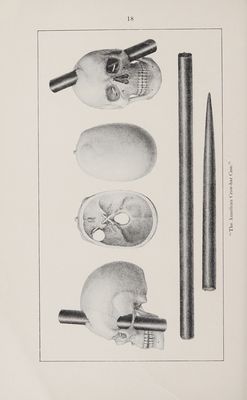
![patient for examination and operation, this surgical procedure was deprived of difficulty. In the same year Dr. Henry J. Bigelow, of Boston, performed excision of the hip for the first time in America. ! Two years previ- ously he had published’ a report of one of the most remarkable surgical cases on record, the famous ‘ American crow-bar case.” The patient, while blasting rock, was engaged in tamping powder in a hole, using for that purpose an iron crow-bar weighing thirteen and a half pounds. The powder exploded prematurely, driving the bar upward in such a manner that it entered the man’s head at the angle of the jaw and passed upward and out through the middle of the frontal bone. The patient made an almost complete recovery, suffering no permanent injury beyond the loss of vision in one eye. Dr. Bigelow wrote many other articles of great value, the most im- portant probably being his Boylston Prize Essay on “ The Hip.” A most valuable procedure, the discovery of which is to be eredited entirely to American genius, was that of thoracentesis. Dr. Henry J. Bowditch’ had long been dissatisfied with the futility of attempting to relieve pleural effusions by the usually employed methods of sali- vation, bleeding, and blistermg. Efforts to relieve effusion by in- cision had been tried many times before by physicians, but had always ended disastrously because of infection. Dr. Bowditch’s first attempt at aspiration proved a failure because of the faulty construction of his instrument. In the meantime Dr. Morrill Wyman, of Cambridge, Mass., had invented a useful form of aspi- rator, and Bowditch, learning of the instrument, procured one. After modifying it somewhat he was able to accomplish his pur- pose, publishing the first account of the operation in 1852. In 1863 he published a statement of his results for the preceding eleven years, consisting of 204 cases, in which he had aspirated 325 times with perfect safety. Many important studies on the pathology of the thoracic viscera were made by the late lamented J. M. Da Costa, of which may be mentioned his exhaustive study of the pathological anatomy of croupous pneumonia,’ and a paper’ on “ Functional Cardiac Mur- murs,” defining their real value as aids to diagnosis. In 1871 he contributed to the Journal his valuable observations on the “ Trritable Heart of Soldiers,” a condition that had been previously reported on by Dr. Alfred Stillé and Dr. Henry Hartshorne.’ 1 The American Journal] of the Medical Sciences, July, 1852. 2 Ibid., July, 1850. 3 Tbid., April, 1852, and April, 1863. 4 Tbid., October, 1855. 5 Ibid., July, 1869. 6 Ibid., July, 1864.](https://iiif.wellcomecollection.org/image/b33447147_0021.jp2/full/800%2C/0/default.jpg)
 No text description is available for this image
 No text description is available for this image
 No text description is available for this image