Treatment of croupous pneumonia in children / by Joseph E. Winters.
- Winters, Joseph Edcil, 1848-1922.
Licence: Public Domain Mark
Credit: Treatment of croupous pneumonia in children / by Joseph E. Winters. Source: Wellcome Collection.
Provider: This material has been provided by The Royal College of Surgeons of England. The original may be consulted at The Royal College of Surgeons of England.
3/16 page 3
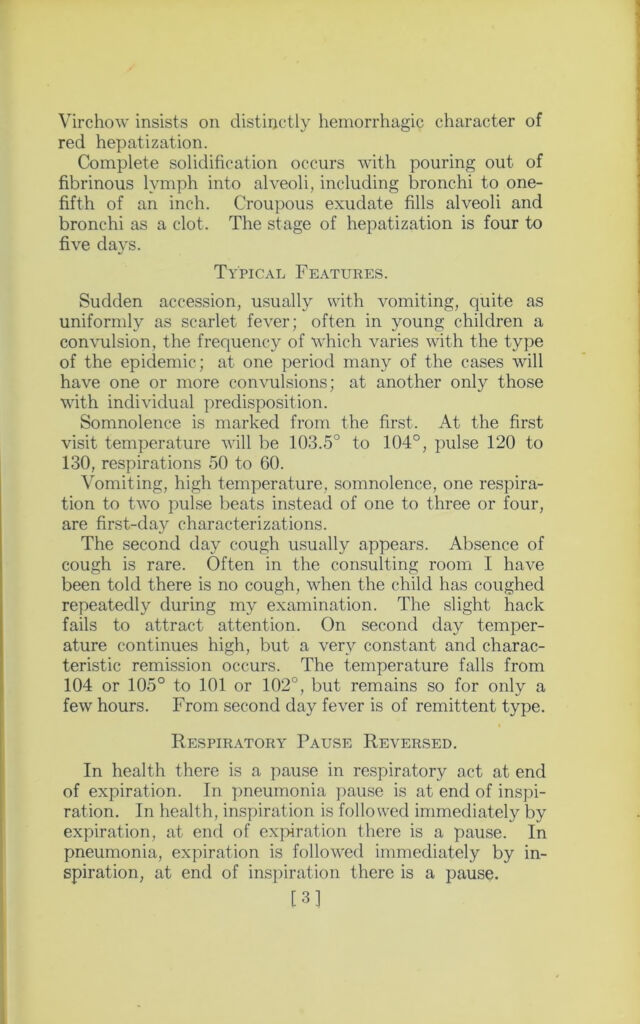
![Virchow insists on distinctly hemorrhagic character of red hepatization. Complete solidification occurs with pouring out of fibrinous lymph into alveoli, including bronchi to one- fifth of an inch. Croupous exudate fills alveoli and bronchi as a clot. The stage of hepatization is four to five days. Typical Features. Sudden accession, usually with vomiting, quite as uniformly as scarlet fever; often in young children a convulsion, the frequency of which varies with the type of the epidemic; at one period many of the cases will have one or more convulsions; at another only those with individual predisposition. Somnolence is marked from the first. At the first visit temperature will be 103.5° to 104°, pulse 120 to 130, respirations 50 to 60. Vomiting, high temperature, somnolence, one respira- tion to two pulse beats instead of one to three or four, are first-day characterizations. The second day cough usually appears. Absence of cough is rare. Often in the consulting room I have been told there is no cough, when the child has coughed repeatedly during my examination. The slight hack fails to attract attention. On second day temper- ature continues high, but a very constant and charac- teristic remission occurs. The temperature falls from 104 or 105° to 101 or 102°, but remains so for only a few hours. From second day fever is of remittent type. Respiratory Pause Reversed. In health there is a pause in respiratory act at end of expiration. In pneumonia pause is at end of inspi- ration. In health, inspiration is followed immediately by expiration, at end of expiration there is a pause. In pneumonia, expiration is followed immediately by in- spiration, at end of inspiration there is a pause. [3]](https://iiif.wellcomecollection.org/image/b22480201_0005.jp2/full/800%2C/0/default.jpg)