[Report 1950] / Medical Officer of Health, Cockermouth R.D.C.
- Cockermouth (England). Rural District Council.
- Date:
- 1950
Licence: Attribution 4.0 International (CC BY 4.0)
Credit: [Report 1950] / Medical Officer of Health, Cockermouth R.D.C. Source: Wellcome Collection.
27/36 page 25
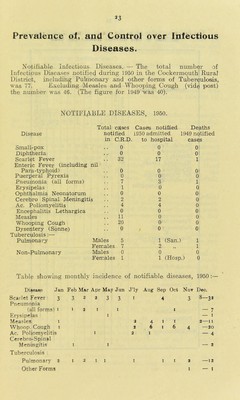
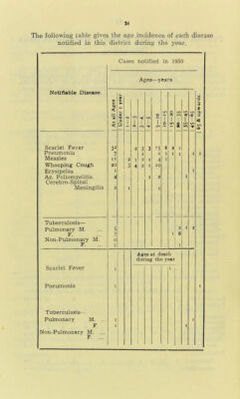
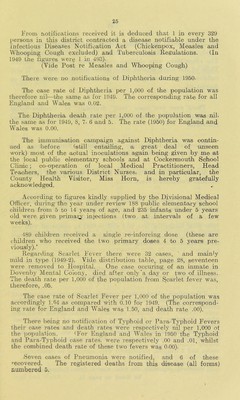
![From notifications received it is deduced that 1 in every 329 persons in this distnct contracted a disease notifiable under the Infectious Diseases Notification Act (Chickerupox, Measles and Whooping Cougih excluded) and Tuberculoisis Regulations. (In 1949 the figures werg 1 in 493). (Vide Post re Measles and Wbooping Cougih) There weie no notifications of Diphtheria dunng 1950. The case rate of Diphtheria per 1,000 of the population was therefore nil—the same as for 1949. The corresponding rate for all England and Wales was 0.02. The Diphtheria death rate per 1,000 of the population wia«s nil. the same as for 1949, 8, 7. 6 and 5. The rate (1950) for England and Wales was 0.00. The immunisation campaign against Diphtheria was contin- ued as before (still entailing, a great deal of unseen work) most of the actual inoculations again being given by me at the local public elementary schools and at Cockermouth School Clinic; co-operation of local Medical Practitioners, Head Teachers, the various District Nurses, and in particular, the County Health Visitor, Miss Horn, is hereby gratefully acknowledged. According to figures kindly supplied by the Divisional Medical Officer, duiing the year under review 188 public elementary school children from 5 to 14 years of age, and 235 infants under 5 years old were given pnmai;y ini'ections (two at intervals of a few weeks). 489 children received a single re-inforcing dose (these are children who received the two primary doses 4 to 5 yeara pre- viously).’ Regarding Scarlet Fever there were 32 oases, ' and main'y mild in type (1949-2). Vide distribution table, page 28, seventeen were removed to liospital. One case occuring of an inmate in Dovenby Mental Colony, died after onty’a day or two of illness. The death rate per 1,000 of the population from S.carlet fever was, therefore, .05. The case rate of Scarlet Fever per 1,000 of the population was accordingly 1.64 as compared with 0.10 for 1949. (The correspond- ing rate for England and Wales was 1.50, and death rate .00). There being no notification of Typhoid or Para-Typhoid Fevers their case mtes and death rates were respectively nil per 1,000 of the ])opulation. •'For England and Wales in 1950 the Typhoid and Para-Typhoid case rates, were respectively .00 and .01, whilst the combined death rate of these two fevers was 0 00). Seven cases of Pneumonia were notified, and 6 of these ‘■ecovered. The registered deaths from this disease (all forms) numbered 5.](https://iiif.wellcomecollection.org/image/b29117859_0027.jp2/full/800%2C/0/default.jpg)