A manual and dictionary of the flowering plants and ferns / by J.C. Willis.
- John Christopher Willis
- Date:
- 1908
Licence: In copyright
Credit: A manual and dictionary of the flowering plants and ferns / by J.C. Willis. Source: Wellcome Collection.
232/740 page 212
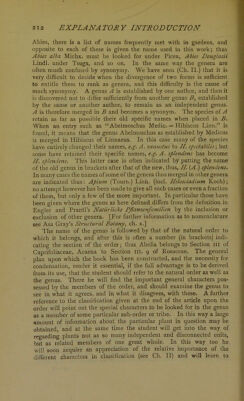
![Abies, there is a list of names frequently met with in gardens, and opposite to each of these is given the name used in this work; thus Abies alba Michx. must be looked for under Picea, Abies Douglasii Lindl. under Tsuga, and so on. In the same way the genera are often much confused by synonymy. We have seen (Ch. II.) that it is very difficult to decide when the divergence of two forms is sufficient to entitle them to rank as genera, and this difficulty is the cause of much synonymy. A genus A is established by one author, and then it is discovered not to differ sufficiently from another genus B, established by the same or another author, to remain as an independent genus. A is therefore merged in B and becomes a synonym. The species of A retain as far as possible their old specific names when placed in B. When an entry such as “Abelmoschus Medic. = Hibiscus Linn.” is found, it means that the genus Abelmoschus as established by Medicus is merged in Hibiscus of Linnaeus. In this case many of the species have entirely changed their names, e.g. A. venustus to H. spectabilis; but some have retained their specific names, e.g. A. splendens has become II. sphndcns. This latter case is often indicated by putting the name of the old genus in brackets after that of the new, thus, H. (A.) splendens. In many cases the names of some of the genera thus merged in other genera are indicated thus: Apiuni (Tourn.) Linn, (inch Helosciadium Koch); no attempt however has been made to give all such cases or even a fraction of them, but only a few of the more important. In particular those have been given where the genus as here defined differs from the definition in Engler and Prantl’s Naliirliche Pflanzenfamilien by the inclusion or exclusion of other genera. [For further information as to nomenclature see Asa Gray’s Structural Botany, ch. x.] The name of the genus is followed by that of the natural order to which it belongs, and after this is often a number (in brackets) indi- cating the section of the order; thus Abelia belongs to Section III of Caprifoliaceae, Acaena to Section III. 9 of Rosaceae. The general plan upon which the book has been constructed, and the necessity for condensation, render it essential, if the full advantage is to be derived from its use, that the student should refer to the natural order as well as the genus. There he will find the important general characters pos- sessed by the members of the order, and should examine the genus to see in what it agrees, and in what it disagrees, with these. A further reference to the classification given at the end of the article upon the order will point out the special characters to be looked for in the genus as a member of some particular sub-order or tribe. In this way a large amount of information about the particular plant in question may be obtained, and at the same time the student will get into the way of regarding plants not as so many independent and disconnected units, but as related members of one great whole. In this way too he will soon acquire an appreciation of the relative importance of the different characters in classification (see Ch. II) and will learn to](https://iiif.wellcomecollection.org/image/b28133389_0232.jp2/full/800%2C/0/default.jpg)
 No text description is available for this image
 No text description is available for this image
 No text description is available for this image