A manual and dictionary of the flowering plants and ferns / by J.C. Willis.
- John Christopher Willis
- Date:
- 1908
Licence: In copyright
Credit: A manual and dictionary of the flowering plants and ferns / by J.C. Willis. Source: Wellcome Collection.
251/740 page 231
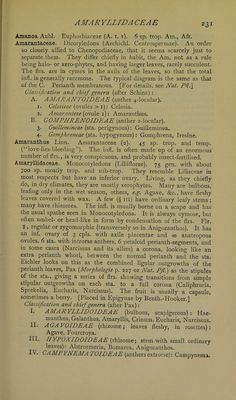
![A MAR YLLIDA CEAE Amanoa Aubl. Euphorbiaceae (A. I. 1). 6 sp. trop. Am., Afr. Amarantaceae. Dicotyledons (Archichl. Centrospermae). An order so closely allied to Chenopodiaceae, that it seems scarcely just to separate them. They differ chiefly in habit, the Am. not as a rule being halo- or xero-phytes, and having larger leaves, rarely succulent. The flrs. are in cymes in the axils of the leaves, so that the total infl. is generally racemose. The typical diagram is the same as that of the C. Perianth membranous. [For details, see Nat. Pfl.\ Classification and chief genera (after Schinz) : A. AMARANTOIDEAE (anther 4-locular). 1. Celosieae (ovules > 1): Celosia. 2. Amaranteae [ovule 1): Amaranthus. B. GOMPHRENOIDEAE (anther 2-locuIar). 3. Guillemineae (sta. perigynous): Guilleminea. 4. Gomphreneae (sta. hypogynous): Gomphrena, Iresine. Amaranthus Linn. Amarantaceae (2). 45 sp. trop. and temp. (“love-lies-bleeding”). The infl. is often made up of an enormous number of firs., is very conspicuous, and probably insect-fertilised. Amaryllidaceae. Monocotyledons (Liliiflorae). 75 gen. with about 700 sp. mostly trop. and sub-trop. They resemble Liliaceae in most respects but have an inferior ovary. Living, as they chiefly do, in dry climates, they are mostly xerophytes. Many are bulbous, leafing only in the wet season, others, e.g. Agave, &c., have fleshy leaves covered with wax. A few (§ in) have ordinary leafy stems; • many have rhizomes. The infl. is usually borne on a scape and has the usual spathe seen in Monocotyledons. It is always cymose, but often umbel- or head-like in form by condensation of the flrs. Fir. S , regular or zygomorphic (transversely so in Anigozanthos). It has an inf. ovary of 3 cpls. with axile placentae and 00 anatropous ovules, 6 sta. with introrse anthers, 6 petaloid perianth-segments, and in some cases (Narcissus and its allies) a corona, looking like an extra perianth whorl, between the normal perianth and the sta. Eichler looks on this as the combined ligular outgrowths of the perianth leaves, Pax [Morphologic p. 227 or Nat. Pfi.) as the stipules of the sta., giving a series of flrs. showing transitions from simple stipular outgrowths on each sta. to a full corona (Caliphruria, Sprekelia, Eucharis, Narcissus). The fruit is usually a capsule, sometimes a berry. [Placed in Epigynae by Benth.-Hooker.] Classification and chief genera (after Pax): I. AMARYLLIDOIDEAE (bulbous, scapigerous): Hae- manthus, Galanthus, Amaryllis, Crinum, Eucharis, Narcissus. II. AGAVOIDEAE (rhizome; leaves fleshy, in rosettes): Agave, Fourcroya. III. HYPOXIDOIDEAE (rhizome; stem with small ordinary leaves): Alstroemeria, Bomarea, Anigozanthos. IV. CAMPYNEMA TOIDEAE (anthersextroi.se): Campynema.](https://iiif.wellcomecollection.org/image/b28133389_0251.jp2/full/800%2C/0/default.jpg)