A special report on an infants' milk depot, established under the auspices of the Finsbury Social Workers' Association / by George Newman.
- Finsbury (London, England). Public Health Committee.
- Date:
- 1905
Licence: In copyright
Credit: A special report on an infants' milk depot, established under the auspices of the Finsbury Social Workers' Association / by George Newman. Source: Wellcome Collection.
Provider: This material has been provided by The Royal College of Surgeons of England. The original may be consulted at The Royal College of Surgeons of England.
12/60 page 10
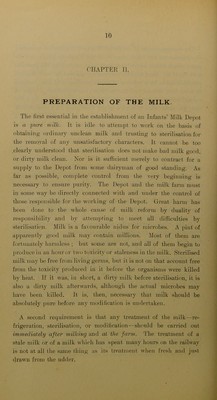
![OHAPTEli II. PREPARATION OF THE MILK. The first essential in the establishment of an Infants’ ]\Iilh Depot is a pure milk. It is idle to attempt to work on the basis of obtaining ordinary unclean milk and trusting to sterilisation for the removal of any unsatisfactory characters. It cannot be too .clearly understood that sterilisation does not make bad milk good, or dirty milk clean. Nor is it sufficient merely to contract for a supply to the Dej)ot from some dairyman of good standing. As far as possible, complete control from the very beginning is necessary to ensure purity. The Depot and the milk farm must in some way be directly connected with and under the control of those responsible for the working of the Depot. Great harm has been done to the whole cause of milk reform by duality of responsibility and by attempting to meet all difficulties by sterilisation. Milk is a favourable Jiidus foi‘ microbes. A pint'of apparently good milk may contain millions. J\Iost of them are fortunately harmless ; but some are not, and all of them begin to produce in an hour or two tcjxicity or staleness in the milk. Sterilised milk may be free from living germs, but it is not on that account free from the toxicity produced in it before the organisms were killed by heat. If it was, in short, a dirty milk before sterilisation, it is also a dirty milk afterwards, although the actual microbes may have been killed. It is, then, necessary that milk should be absolutely ]3ure before any modification is underlakeji. A second requirement is that any treatment of the milk—re- frigeration, sterilisation, or modification —should be carried out immediately after milking and at the farm. The treatment of a stale milk or of a milk which has spent many hours on the railway is not at all the same thing as its treatment when fresh and just drawn from the udder,](https://iiif.wellcomecollection.org/image/b22401210_0012.jp2/full/800%2C/0/default.jpg)


 No text description is available for this image
 No text description is available for this image
 No text description is available for this image