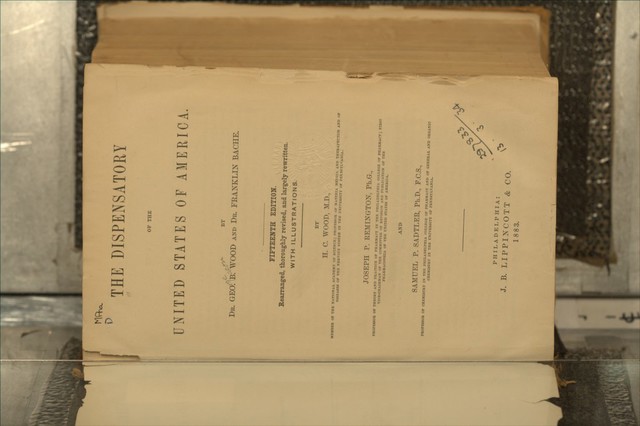
The dispensatory of the United States of America / by Geo. B. Wood and Franklin Bache.
- Date:
- 1883
Licence: Public Domain Mark
Credit: The dispensatory of the United States of America / by Geo. B. Wood and Franklin Bache. Source: Wellcome Collection.
Provider: This material has been provided by the Gerstein Science Information Centre at the University of Toronto, through the Medical Heritage Library. The original may be consulted at the Gerstein Science Information Centre, University of Toronto.
35/1944 page 23
![stability to the alkaloid, which is very liable to decomposition, especially under the influence of heat. It may be used for all the purposes for which lobelia is given, either in substance or tincture, as in asthma, spasmodic catarrh, and catarrhal croup, in which it may often be advantageously conjoined with the syrups of seneka and squill. For these purposes the dose for an adult is from thirty minims to a fluidrachm (2-3-75 C.c), repeated three or four times a day, or mure frequently if required, lu the paroxysm of spasmodic asthma one or two fluidrachms (3-75—750 C.c.) may be given every two or three hours till relief is obtained. The emetic dose would be half a fluidounce (15 C.c.}. ACETUM OPII. U.S. Vinegar of Opium. (.\-CE'TUM O'PI-i.) Black Drop; Vinaigre d'Opium, Fr.; Opium-Essig, G. Powdered Opium, tenparts\_or two ounces av.] ; Nutmeg, in No. 30 powder, three parts [or two hundred and sixty grains] ; Sugar, ticenti/ parts [or four ounces av.] ; Diluted Acetic Acid, a sufficient quantity^ To make one hundred parts [or eighteen fluidounces.] Macerate the Opium and Nutmeg xxi jifty parts [or in nine fluidounces] of Diluted Acetic Acid for twenty-four hours. Put the mixture into a conical glass percolator, and return the percolate until it passes clear. Then gradually pour on Diluted Acetic Acid until eighty parts [or one pint] of liquid are obtained. In this dissolve the Sugar by agitation without heat and strain. U.S. Many will doubtless prefer to make this preparation entirely by maceration. This may be done by placing the powder in a suitable bottle and pouring on the diluted acetic acid, agitating frequently, after allowing the maceration to proceed seven days, expressing and filtering. The vinegar of opium was introduced into the Pharma- copoeias as an imitation of or substitute for a preparation which has been long in use under the name of Lancaster or Quaker black drop, or simply black drop. The formula of the first edition of the U. S. Pharmacopoeia was so deficient in pre- cision, and so uncertain in its results, that it was abandoned in the second edition; but, as these objections were obviated in a process by Mr. Charles Ellis {A.J. P., vol. ii. p. 202), it was deemed proper to restore it to its officinal rank at the subsequent revision of the Pharmacopoeia. The preparation has, we think unfortunately, been omitted in the British Pharmacopceia with most of the other vinegars. The ad- vantages of the black drop over laudanum are, probably, that disturbing principles con- tained in opium and soluble in alcohol are left behind by the aqueous menstruum employed; while the meconate of morphia is converted by the acetic acid into the acetate. In the original process, published by Dr. Armstrong, who found it among the papers of a relative of the proprietor in England, verjuice, or the juice of the wild crab, was employed instead of vinegar. Other vegetable acids also favorably modify the narcotic operation of opium; and lemon-juice has been employed in a similar manner with vinegar or verjuice, and perhaps not less advantageously. For the process officinal in first edition U. S. Pharm., see 14th edition U. S. Dispensatory. The vinegar of opium may sometimes be advantageously used when opium itself, or the tincture, occasions headache, nausea, or nervous disorder. It exhibits all the anodyne and soporific properties of the narcotic, with less tendency to produce these disagreeable eflfects. The strength of this preparation has been more seriously altered than that of any other of the vinegars; it is now, in opium strength, one-third iceaker than the black drop formerly officinal. One grain of opium was contained in 6'-4 minims or 6-65 grains of the former black drop, whilst now one grain is contained in 9-6 minims or 10 grains of the present preparation. Formerly black drop was double the strength of laudanum ; it has now the same strength. This alteration is in our opinion absolutely unjustifiable, and, if the preparation were more frequently used, would very probably lead to loss of life. It would be well for the present to note upon prescriptions after Acetum Opii, [T. S.F., 18S0,] as a safeguard, and to revise the dose accordingly. The dose may be stated at from ten to fifteen drops or minims (060 to 1 C.c.) of the vinegar of opium {Pharm., 1880).](https://iiif.wellcomecollection.org/image/b20996949_0035.jp2/full/800%2C/0/default.jpg)



 No text description is available for this image
 No text description is available for this image
 No text description is available for this image