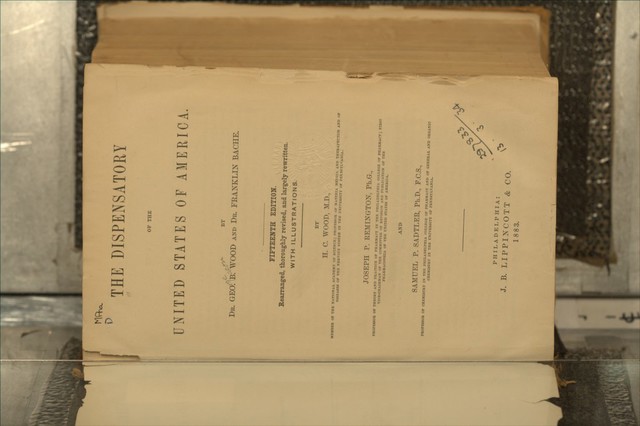
The dispensatory of the United States of America / by Geo. B. Wood and Franklin Bache.
- Date:
- 1883
Licence: Public Domain Mark
Credit: The dispensatory of the United States of America / by Geo. B. Wood and Franklin Bache. Source: Wellcome Collection.
Provider: This material has been provided by the Gerstein Science Information Centre at the University of Toronto, through the Medical Heritage Library. The original may be consulted at the Gerstein Science Information Centre, University of Toronto.
41/1944 page 29
![It is difficult to ascertain the strength of acetic acid by saturating it with the carbonated alkalies, when the operator depends upon test-paper for ascertaining the point of neutralization. The difficulty is caused by the fact that the acetates of potassium and sodium, though neutral in composition, are alkaline to test-paper. Hence the liquid begins to be alkaline to test-paper, while some free acid yet remains, but insufficient to overcome the alkaline reaction of the salt formed. It follows, there- fore, that by the use of test-paper the strength of the acetic acid will be underrated. The degree of inaccuracy, where test-paper is used, is much diminished by saturating the acid with a solution of saccharate of calcium, of a known strength, as proposed by Mr. C. G. \\*illiams. {P. J. Tr., May, 1S54, p. 594.) A still better way is to add to the acid a weighed excess of carbonate of barium, and to calculate its strength by the amount of the carbonate decomposed, ascertained by deducting the undissolved from the total used. (Reduood.) Equally accurate results may be obtained by the use of carbonate of calcium in a simifer manner. (E. C. Nicholson and D. S. Price, Chem. Gaz., Jan. 15, 1856.) TJses of Crude Pyroligneous Acid. This acid having been incidentally described as the source of the acetic acid of commerce, it may be proper in this place to notice its uses. It has been employed as an application to gangrene and ill-conditioned ulcers. It acts on the principle of an antiseptic and stimulant; the former property being in part due to the presence of creasote. Several ca.ses in which it was successfully employed are reported in a paper by Dr. T. Y. Simons, of Charleston, S. C. (vim. Journ. of Med. Sci., 0. S., v. 310.) The crude acid is advantageously applied to the preservation of animal food. Mr. William Ramsey made some interesting experiments with it for that purpose. Her- rings and other fish, simply dipped in the acid and afterwards dried in the shade, were effectually preserved, and when eaten were found very agreeable to the taste. Herrings, slightly cured with salt by being sprinkled with it for six hours, then drained, next immersed in pyroligneous acid for a few seconds, and afterwards dried in the shade for two months, were found by Mr. Ramsey to be of fine quality and flavor. Fresh beef, dipped in the acid in summer for the space of a minute, was perfectly sweet in the following spring. ProfeSv«or Silliman states that one quart of the acid, added to the common pickle for a barrel of hams, at the time they are laid down, will impart to them the smoked flavor as perfectly as if they had undergone the ordinary process of smoking, Acidum Aceticum Dilutu.m. U. S., Br. Diluted Acetic Acid. Acetic Acid seventeen parts [or one pint]; Distilled Water eighty-three parts [or five and one- eighth pints], To make one hundred parts. Mix them. Diluted acetic acid con- tains 6 per cent, of absolute acetic acid, and has the specific gravity 10083.* It corresponds in properties to acetic acid, and should respond to the same tests of purity. U. S. To neutralize 2-1 Gra. of diluted acetic acid should require 24 C.c. of the volu- metric solution of soda, U. S.; one-fourth the number of cubic centimetres re- quired being the number per cent, of acid contained. Take of Acetic Acid one p>i>d [Imperial measure] ; Distilled Water seven pints [Imp. meas.]. Mix. Br. The sp. gr. of this acid is 1006. 440 grains by weight (one fluidounce [Imp.]) requires for neutralization 313 grain-measures of the volu- metric solution of soda, corresponding to 3 63 per cent, of anhydrous acetic acid. One fluidounce [Imp.], therefore, corresponds to 16 grains of anhydrous acid. Br. The object of having this preparation is to possess a weak solution of pure acetic acid, which may be substituted for distilled vinegar in all formulas in which nicety is required. The strength of this preparation was seriously changed at the recent U.S. revision. For a long period diluted acetic acid has been made by mixing one part of acetic acid with seven of water by measure. The officinal diluted acid is now consider- ably stronger, as will be seen by consulting the alternative formula. This change is of doubtful utility ; in our opinion it would have been better to have made the diluted acid to contain 5 per cent, of absolute acid. This would not have materially altered * Experiments made by Mr. C. F. Zeller indicate that the speci6c gravity of diluted acetic acid, by U. S. P. formula, should be 1-013 instead of 10083.](https://iiif.wellcomecollection.org/image/b20996949_0041.jp2/full/800%2C/0/default.jpg)


 No text description is available for this image
 No text description is available for this image
 No text description is available for this image