Volume 1
The early naturalists : their lives and work (1530-1789) / by L.C. Miall.
- Louis Compton Miall
- Date:
- 1912
Licence: Public Domain Mark
Credit: The early naturalists : their lives and work (1530-1789) / by L.C. Miall. Source: Wellcome Collection.
25/418 page 9
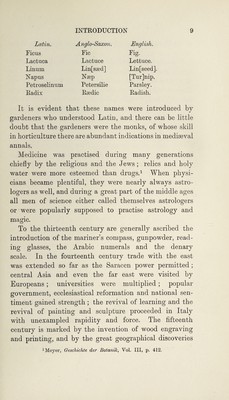
![Latin. Anglo-Saxon. English. Ficus Fic rig. Lactuca Lactuce Lettuce. Linum Lin[ssed] Lin[seed]. Napus Naep [Turjnip. Petroselinum Petersilie Parsley. Radix Rsedic Radish. is evident that these names were introduced by gardeners who understood Latin, and there can be little doubt that the gardeners were the monks, of whose skill in horticulture there are abundant indications in mediaeval annals. Medicine was practised during many generations chiefly by the religious and the Jews ; relics and holy water were more esteemed than drugs.1 When physi¬ cians became plentiful, they were nearly always astro¬ logers as well, and during a great part of the middle ages all men of science either called themselves astrologers or were popularly supposed to practise astrology and magic. To the thirteenth century are generally ascribed the introduction of the mariner’s compass, gunpowder, read¬ ing glasses, the Arabic numerals and the denary scale. In the fourteenth century trade with the east was extended so far as the Saracen power permitted ; central Asia and even the far east were visited by Europeans ; universities were multiplied ; popular- government, ecclesiastical reformation and national sen¬ timent gained strength ; the revival of learning and the revival of painting and sculpture proceeded in Italy with unexampled rapidity and force. The fifteenth century is marked by the invention of wood engraving and printing, and by the great geographical discoveries](https://iiif.wellcomecollection.org/image/b31353691_0001_0025.jp2/full/800%2C/0/default.jpg)

 No text description is available for this image
 No text description is available for this image
 No text description is available for this image