Quarterly report of the Edinburgh Surgical Hospital from August to November 1829 / by James Syme.
- James Syme
- Date:
- [1829]
Licence: Public Domain Mark
Credit: Quarterly report of the Edinburgh Surgical Hospital from August to November 1829 / by James Syme. Source: Wellcome Collection.
Provider: This material has been provided by The Royal College of Surgeons of England. The original may be consulted at The Royal College of Surgeons of England.
5/9 page 4
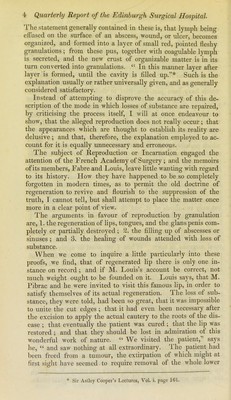
![The statement generally contained in these is, that lymph being eflused on the surface of an abscess, wound, or ulcer, becomes organized, and formed into a layer of small red, pointed fleshy granulations; from these pus, together with coagulable lymph is secreted, and the new crust of organizable matter is in its turn converted into granulations. “ In this manner layer after layer is formed, until the cavity is filled up.”* Such is the explanation usually or rather universally given, and as generally considered satisfactory. Instead of attempting to disprove the accuracy of this de- scri])tion of the mode in which losses of substance are repaired, by criticising the process itself, I will at once endeavour to show, that the alleged reproduction does not really occur; that the appearances which are thought to establish its reality are delusive; and that, therefore, the explanation employed to ac- count for it is equally unnecessary and erroneous. The subject of Reproduction or Incarnation engaged the attention of the French Academy of Surgery; and the memoirs of its members, Fabre and Louis, leave little waiiting with regard to its history. How they have happened to be so completely forgotten in modern times, as to permit the old doctrine of regeneration to revive and flourish to the suppression of the truth, I cannot tell, but shall attempt to place the matter once more in a clear point of view. The arguments in favour of reproduction by granulation are, 1. the regeneration of lips, tongues, and the glans penis com- pletely or partially destroyed; 2. the filling up of abscesses or sinuses; and 3. the healing of wounds attended with loss of substance. When we come to inquire a little particularly into these proofs, we find, that of regenerated lip there is only one in- stance on record; and if M. Louis’s account be correct, not much weight ought to be founded on it. Louis says, that M. Pibrac and he were invited to visit this famous lip, in order to satisfy themselves of its actual regeneration. The loss of sub- stance, they were told, had been so great, that it was impossible to unite the cut edges; that it had even been necessary after the excision to apply the actual cautery to the roots of the dis- ease ; that eventually the patient was cured ; that the lip was restored; and that they should be lost in admiration of this wonderful work of nature. “ We visited the patient,” says he, “ and saw nothing at all extraordinary. The patient had been freed from a tumour, the extirpation of which might at first sight have seemed to require removal of the whole lower Sir Astley Cooper’s Lectures, Vol. i. page lO'l.](https://iiif.wellcomecollection.org/image/b22390583_0006.jp2/full/800%2C/0/default.jpg)