Two suggestions in surgical technique. I. A new method of compressing the subclavian artery. II. A new method of ascertaining whether the bladder is or is not ruptured / by W.W. Keen.
- William Williams Keen
- Date:
- 1890
Licence: Public Domain Mark
Credit: Two suggestions in surgical technique. I. A new method of compressing the subclavian artery. II. A new method of ascertaining whether the bladder is or is not ruptured / by W.W. Keen. Source: Wellcome Collection.
Provider: This material has been provided by The Royal College of Surgeons of England. The original may be consulted at The Royal College of Surgeons of England.
3/6
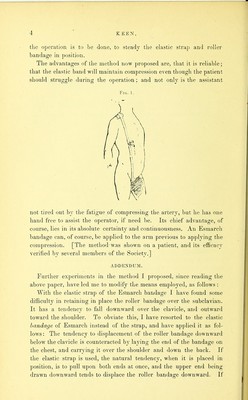
![TWO SUGGESTIONS TN SURGICAL TECIINIOUE. I. A New Method of Compressing the Subclavian Artery. 11. A New Method of Ascertainin<j whether the Bladder is OR IS NOT Ruptured. By W. W. keen, M.D., PROFESSOR OF SURGERY IN THE JEFFERSON MEIJICAI, COLT.EGE. [Read Ffl.iuarv Yi, 1«)U.] I. Compression of the Subclavian Artery. All surgeons know the difficulty of maintaining steady and eflectual occlusion of the subclavian artery by pressure above the clavicle on the third part of the artery where it crosses the first rib. A recent and difficult case that I witnessed drew my attention to the subject afresh, and it occurred to me that compression might be much more effectually accomplished by an elastic band passing over the shoulder, down the back, under the perineum, and up in front of the trunk. It is analogous in its mode of action to Mr. Jordan Lloyd's method of compressing the external iliac artery. I have had no opportunity of putting it into practice in any actual operation about the shoulder- joint, but I have tried it on the living, and found it perfectly effectual and easy of accomplishment. The strong elastic strap or band which comes with Esmarch's rubber bandage is the best means of applying the pressure. A suitable roller bandage, two inches wide, is placed above tlie clavicle over the posi- tion of the artery as ascertained by the touch. The elastic strap is then passed, as described, over the roller bandage, down the back, between the thighs, and up in front of the trunk. The ends can either be held by an assistant, or, better still, be tied or hooked together. (Fig. 1.) If it is desired to release the artery, the rubber strap is slipped of! the bandage ; pi-essure can be renewed as easily. An assist- ant should stand on the side of the patient opposite to that on which](https://iiif.wellcomecollection.org/image/b22277067_0005.jp2/full/800%2C/0/default.jpg)