Foods, their composition and analysis : a manual for the use of analytical chemists and others : with an introductory essay on the history of adulteration / by Alexander Wynter Blyth.
- Date:
- 1896
Licence: Public Domain Mark
Credit: Foods, their composition and analysis : a manual for the use of analytical chemists and others : with an introductory essay on the history of adulteration / by Alexander Wynter Blyth. Source: Wellcome Collection.
Provider: This material has been provided by the Royal College of Physicians of Edinburgh. The original may be consulted at the Royal College of Physicians of Edinburgh.
182/844 page 138
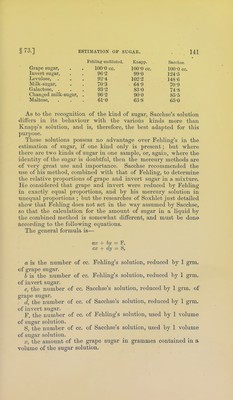
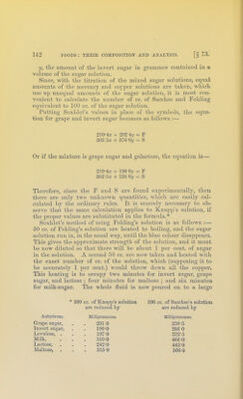
![The starcliy substance is purified by boiling with a mixture •of alcohol and ether to remove fat; it is next digested with cold water to remove sugar and soluble albuminoids; the purified starch is dried, and a grm. is heated with 50 cc. of water in the water-bath for an hour; to the hot solution a gi*m. of oxalic acid in 25 cc. of water is added, and the mixture heated for two hours ; at the end of which time the liquid is cooled, made «p with water to 100 cc, filtered, and an aliquut part examined in a Laurent's or other saccharimeter, and also the reducing power ascertained by means of the cyanide copper process (p. 143). The degrees of rotation wliich the sugar found should produce are subtracted from the total rotation, the result Vjeing the I'ota- tion due to dextrin; the sugar found is then multiplied by 0*9 for 100 parts of sugar = 90 starch, the amount of dextrin added—and the result = starch. (2,) Volumetric Frocesscs hy the, aid of Solutions of certain Salts of Mercury. Knapp's mei'cui-ic cyanide solution is made by dissolving 10 grms. of mercuric cyanide in about 600 cc. of water, then adding 100 cc. of caustic soda solution of specific gravity 1-145, and dilut- ing to 1 litre. 40 cc. of the mercuiy solution are placed in a flask, heated to boiling, and the solution containing sugar run in gradually from a burette, four parts of mercuric cyanide being reduced to metallic mercury for every one part of anhydrous grape sugar (or, 3-174 parts of metallic mercury = 1 anhydrous grape sugar). The ending of the process is discovered by moistening filter-paper with the clear solution, and holding qviite ■close to it a rod dipped in ammonium sulphide solution; a decided brown coloration takes place if the mercury salt is in excess; but if the colour is very faint, the o])eration is finished, for it appears to be impossible to decompose the whole salt, a trace always remaining, and for this reason the solution should be standardised with susar. A. Sacchse uses the following solutioji for the estimation of sugar:—18 grms. of pure dry mei'curic iodide, and 25 grms. of potassic iodide ai^e dissolved in water, a solution of 80 grms. of caustic potash is rdded, and the whole made up to 1 litre. 40 cc. of this solution [-0-72 grm. Hglg] are boiled in a basin, and the solution of grape sugar is run in, until the whole of the mercury is precipitated. The final point is determined by spotting a drop of the supernatant liquid on a white slab, and then bringing it into contact with a drop of a strongly alkaline solution of stannous chloride. The production of a browa colour shows the presence of unprecipitated mercury.](https://iiif.wellcomecollection.org/image/b21901661_0184.jp2/full/800%2C/0/default.jpg)
 No text description is available for this image
 No text description is available for this image
 No text description is available for this image