On the relation of uric acid excretion to diet / by F. Gowland Hopkins and W.B. Hope.
- Frederick Hopkins
- Date:
- [1898?]
Licence: Public Domain Mark
Credit: On the relation of uric acid excretion to diet / by F. Gowland Hopkins and W.B. Hope. Source: Wellcome Collection.
3/32
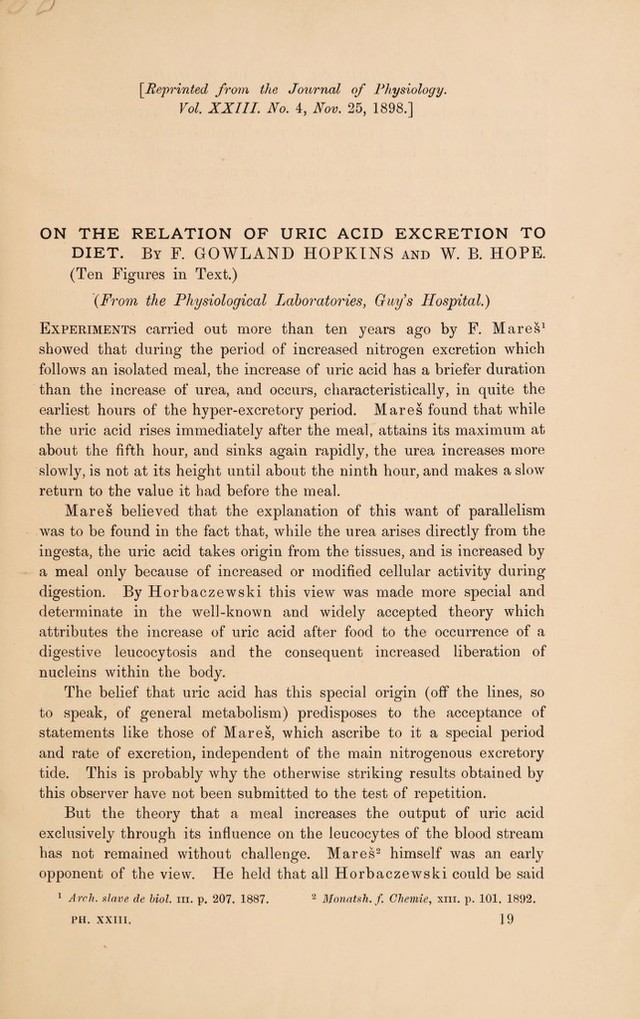
![[Reprinted from the Journal of Physiology. Vol. XXIII. No. 4, Nov. 25, 1898.] ON THE RELATION OF URIC ACID EXCRETION TO DIET. By F. GOWLAND HOPKINS and W. B. HOPE. (Ten Figures in Text.) (From the Physiological Laboratories, Guys Hospital.) Experiments carried out more than ten years ago by F. Mares1 showed that during the period of increased nitrogen excretion which follows an isolated meal, the increase of uric acid has a briefer duration than the increase of urea, and occurs, characteristically, in quite the earliest hours of the hyper-excretory period. Mares found that while the uric acid rises immediately after the meal, attains its maximum at about the fifth hour, and sinks again rapidly, the urea increases more slowly, is not at its height until about the ninth hour, and makes a slow return to the value it had before the meal. Mares believed that the explanation of this want of parallelism was to be found in the fact that, while the urea arises directly from the ingesta, the uric acid takes origin from the tissues, and is increased by a meal only because of increased or modified cellular activity during digestion. By Horbaczewski this view was made more special and determinate in the well-known and widely accepted theory which attributes the increase of uric acid after food to the occurrence of a digestive leucocytosis and the consequent increased liberation of nucleins within the body. The belief that uric acid has this special origin (off the lines, so to speak, of general metabolism) predisposes to the acceptance of statements like those of Mares, which ascribe to it a special period and rate of excretion, independent of the main nitrogenous excretory tide. This is probably why the otherwise striking results obtained by this observer have not been submitted to the test of repetition. But the theory that a meal increases the output of uric acid exclusively through its influence on the leucocytes of the blood stream has not remained without challenge. Mares2 himself was an early opponent of the view. He held that all Horbaczewski could be said 1 Arch, slave de biol. hi. p. 207. 1887. 2 Monatsh. f. Cheviie, xm. p. 101. 1892. 19 PH. XXIII,](https://iiif.wellcomecollection.org/image/b3047520x_0003.jp2/full/800%2C/0/default.jpg)