On the relation of uric acid excretion to diet / by F. Gowland Hopkins and W.B. Hope.
- Frederick Hopkins
- Date:
- [1898?]
Licence: Public Domain Mark
Credit: On the relation of uric acid excretion to diet / by F. Gowland Hopkins and W.B. Hope. Source: Wellcome Collection.
5/32 page 273
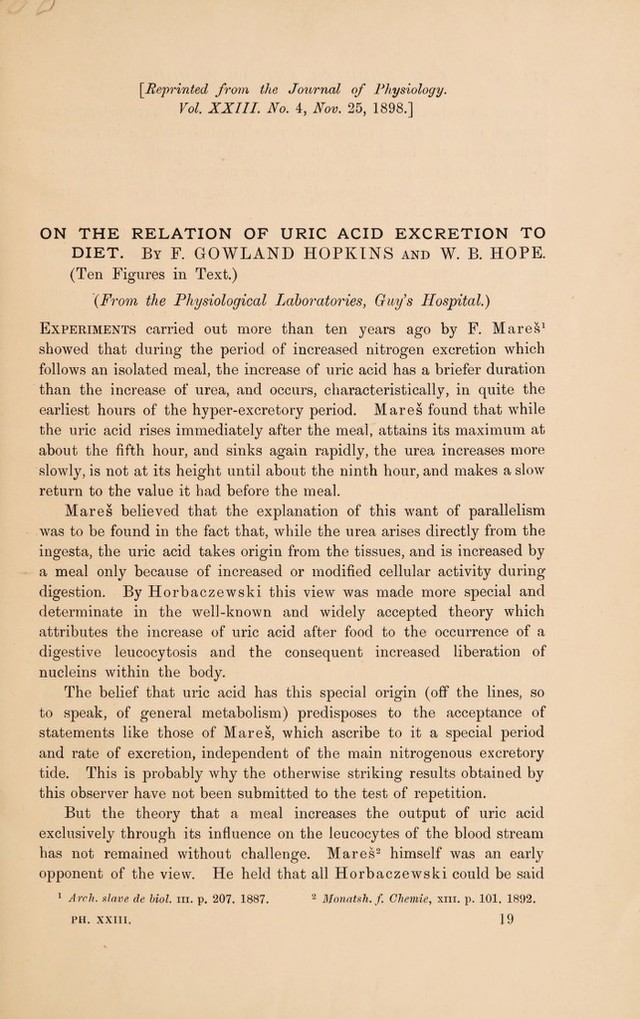
![Methods used in this research. In estimating uric acid Mares used the Salkowski-Ludwig process; his figures are therefore beyond reproach. But his observations were made upon a few individuals only, and upon the urine of consecutive three-hourly periods—intervals too long to permit of the relative rates of excretion of urea and uric acid being accurately followed. In his experiments, moreover, ab¬ normally large meals of proteid were taken. In such of our own experiments as were directed to a repetition of the work of Mares, we kept the following ends in view :—(1) To employ as many individuals as possible, in order that the effects of personal idiosyncrasy might be eliminated. Altogether the sequence of excretion was studied in seven persons (adult males). (2) To test the effect of a meal fully isolated, and so to avoid any interference from the remains of the nitrogenous tide due to previous food ingestion. Mares believed that the excretion of uric acid remained at a nearly constant level from the 13th to the 24th hour of fasting. In our experiments no food was taken after dinner at about 7 p.m., until the test meal was taken at about 1 p.m. on the following day. (3) To test the effect of meals of ordinary mixed diet and of normal dimensions. In general each individual took such a meal as was customary to his habits and appetite. Except for an effect of the preliminary abstinence the conditions of digestion were therefore as normal as possible. The food usually consisted of beef-steak, bread and potatoes. The actual amount of nitrogen ingested was without importance in this part of our enquiry, and was not determined. In later experiments with other bearings, the nitrogen was, when necessary, determined by Kjeldahl’s method. (4) To make the intervals at which consecutive determina¬ tions were made as short as possible. The urine was collected at hourly intervals, generally during the three hours before the meal and up to about the tenth hour after it; determinations being made on each hourly quantity. No food was taken after the test meal until the experiment was finished. The uric acid was determined throughout by the process described by one of us, in which it precipitated as acid ammonium urate by saturating the urine with ammonium chloride; the acid itself being subsequently liberated and titrated with standard permanganate solution. Many observers have now compared this method with the standard Salkowski-Ludwig process and always with favourable results1. ] Of. Huppert. Analyse des Hams, p. 820, Wiesbaden, 1898. 19—2](https://iiif.wellcomecollection.org/image/b3047520x_0005.jp2/full/800%2C/0/default.jpg)