Results of hemisection of the spinal cord in monkeys / by Frederick W. Mott ; communicated by Professor Schäfer.
- Frederick Walker Mott
- Date:
- 1892
Licence: Public Domain Mark
Credit: Results of hemisection of the spinal cord in monkeys / by Frederick W. Mott ; communicated by Professor Schäfer. Source: Wellcome Collection.
Provider: This material has been provided by The Royal College of Surgeons of England. The original may be consulted at The Royal College of Surgeons of England.
25/70 page 23
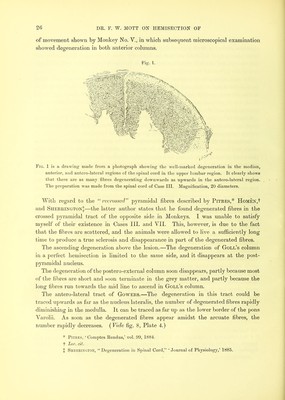
![After careful examination of the spinal cords, especially of Case IIL, facts were elicited with regard to degeneration, which in the main confirm those of previous observers, Singer,* * * § ** Hoivien,!' and Tooth.| Case III. was the most complete hemisection in which the injury was limited to one side {vide 4 and 5, Plate 1). A very small portion of the posterior median column alone lias remained, and this is in great measure degenerated. Plate 2 illustrates this lesion, and the resulting ascending and descending degenerations. The comma-shaped degeneration, visible to the naked eye in the posterior column, on the side of the lesion, for 0’5 centim. below the lesion {vide Plate 2, No. 20, and Plate 4, fig. 10), can be traced down for about 2 centims., the degenerated fibres gradually becoming less and disappearing altogether. I examined a large number of sections, to be sure about it, and I invariahhj found degenerated fibres in the posterior column, on the side corresponding to the degenerated pyramidal tract, and this agrees with the results obtained by Homen§ on the Dog, and Tooth |] figures it after hemisection in the cervical cord of the Monkey. On comparison of the degenerated area with the corresponding area on the opposite side, I was led to believe that the patch of sclerosis was due to a disappearance of a bundle of rather fine medullated fibres. Ramon y Ca.jal^ and Kolliker'' have shown that the fibres of the posterior column, before they enter Clarke’s vesicular column, divide into an ascending and descending set of medullated fibrils. This may be the explanation, or possibly these fibres are vertical commissural connections between the cells of Clarke’s column. In cases where the lesion had not involved the posterior column so completely this degeneration was absent. A number of thin sections of tlie cord, from this case and from No. IV., stained by Pal’s method, were examined with ^-in. Ross and a very high magnifying eye-piece, by which combination a very large field with a sufficiently high magnification and precise definition was obtained. Below the lesion the direct cerebellar tract fibres were observed undegenerated at the periphery of the cord outside the pyramidal tract, as low as the lOth-llth dorsal segment {vide fig. G, Plate 4). * “ Ober secmulare Degeneration im Riickeumarke des Hundes.” Vou Dr. J. Singer, Assist, am Physiol Inst. Prag. Aus dein 84. Bande der ‘ Sitzb. der K. Akad. der Wissenschaften,’ III. Abtli. October Heft. Jalirg. 1881. t Loc. cit. J Loc. cit. § Loc. cit. II Loc. cit. Tf ‘ Anatomisclier Anzeiger,’ 3, 4, 1890. ** “ Zur feineren Anatomie dc.s centralen Nervensystcms.—Zweiter Beitrag. l3as Riickcnmark,” von A. KbiiLiKEii. Separat-Abdrnck au.s ‘ Zeitsclirift fiir Wissenscliaftlicbe Zoologie,’ vol, 51, 1891, p. ]. Leipzig, WnmRMvi Enoelmann.](https://iiif.wellcomecollection.org/image/b22297066_0027.jp2/full/800%2C/0/default.jpg)